

|
|
|
|
| Author |
|
|
Senior Member

Join Date: Mar 2000
Location: Lacey, WA. USA
Posts: 25,312
|
Steve/masraum sent me a PM and generously offered to help me out. Pelicanheads have made me feel proud for twenty years now, and this is the latest instance. Thank you, Steve.
I think I am using my telescope wrongly, and I wonder if I am focusing on the wrong plane. Flatbutt says stars jumped out of nebula. Eric says my magnification should be around 66/1. Pazuzu says color filters can help. Here's the deal: Color filters will not help me because the image would need to be several times larger in order for me to see anything larger than a spec. If I focus just right on Jupiter, I can see it has moons, but Jupiter itself is still WAY too small for any hope of seeing color details. I'm going to return to my original question. Because of some of the comments I see here, I still wonder if I am using this telescope wrongly. The slidey thingie into which the eyepiece is inserted is adjusted so that several inches of the slidey thingie are protruding from the fat part of the telescope. I was given this telescope about 3 months ago and part of my problem is meteorological. The Pacific Northwest is a wet, cloudy place. This time of year there are several nights per month in which we could not even detect the presence of a full moon, so thick is the cloud cover. No more than a handful of nights per month present any opportunity to see anything. Right now, the National Weather Service says it will rain constantly until at least next weekend. I do have a nice neighbor with a telescope I have not seen. Perhaps he can coach me. I think I am focusing this telescope wrongly.
__________________
Man of Carbon Fiber (stronger than steel) Mocha 1978 911SC. "Coco" |
||
 12-18-2021, 06:55 AM
|
|
|
I see you

Join Date: Nov 2002
Location: NJ
Posts: 30,029
|
Quote:
This site gives an estimate of the conditions in your area: https://www.cleardarksky.com/csk/index.html You need to dial in your location. Beyond this you need to ensure that your scope is setup properly. Here is the online manual https://www.manualslib.com/manual/1807283/Celestron-Starsense-Explorer-Dx-102az.html?page=4#manual The slidey thingie is the Focuser and shouldn't need adjustment but check to make sure it isn't loose. You can use the scope during the day to check focus.DON'T POINT IT AT THE SUN. Pick a tree top or something else way off in the distance and play with the focus. It's alot easier to do in daylight DON'T POINT IT AT THE SUN. If you can't get sharp focus then there is something wrong in the light path and the scope may need to be collimated. Rare but it could happen. https://www.ozscopes.com.au/collimating-a-refractor-telescope.html
__________________
Si non potes inimicum tuum vincere, habeas eum amicum and ride a big blue trike. "'Bipartisan' usually means that a larger-than-usual deception is being carried out." |
||
|
12-18-2021, 07:21 AM
|
|
|
Back in the saddle again

Join Date: Oct 2001
Location: Central TX west of Houston
Posts: 56,625
|
Quote:
Quote:
Quote:
I would assume your scope should look a lot like this. 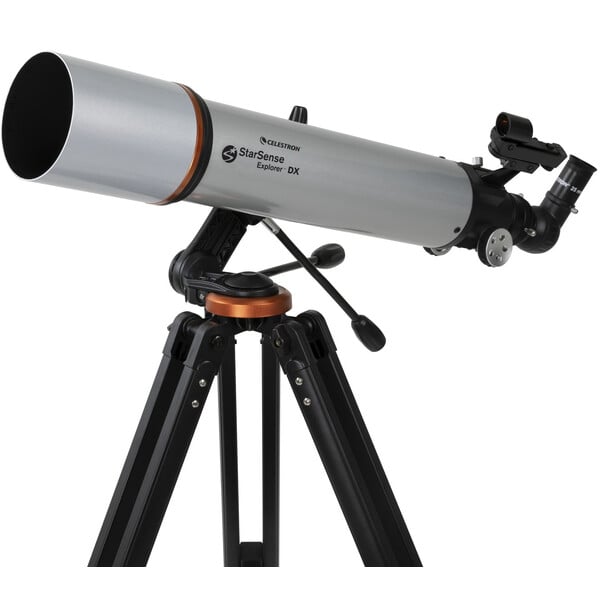 Here's a generic refractor diagram that lists the major parts  There should be the main OTA (optical tube assembly) which is the tube that's got the objective lens and focuser. Then the diagonal should be inserted into the small end where the focuser is. It's possible to not have a diagonal, but I think that would be a bit unusual. Most refractors like that use a diagonal. Then the EP should be inserted into the diagonal. If you don't have a diagonal, that could certainly cause issues with getting things into focus because the length of the diagonal is part of the optical path. Without it, you may never get things into focus. You should only have to focus initially, and then if you change eye pieces. Put in your eye piece, find a relatively bright star (but probably not the brightest in the sky) and then focus until the star is a sharp pinpoint. Anything in the sky should then be in focus (since everything in the sky is essentially at infinity). As far as what you can expect to see of Jupiter when you can get the magnification up there, this is a decent approximation of something that would be a pretty good view. (it's almost impossible to compare photos to what you see with your eyes) On occasional when there is exceptional seeing, you can see more detail  When I've seen the GRS (Great Red Spot), it's usually looked more white. I once saw a hint of pink. Most of the time, when I see it, it looks more like someone took a bit out of the color band that it is embedded in. This photo has a lot of detail which we're pretty unlikely to see, but it has some aspects that to me demonstrate well what I think you would see. The lack of detail on the right hand image (and maybe a bit less, like the small spots wouldn't be detectable) is most closely representative of what I see, mostly just bands of various brightness. I've never seen the GRS look like the image on the right. When I've seen it, it looks more like the image on the left, where there's a dark band, and the spot practically blends in with the light band that it's near. And the dark band looks like someone has taken a bite out of it.  This is reasonably representative of what you can see of saturn. It's mostly just going to be bands of color, and then the "cassini division" (gap in the middle of the rings.  I've seen a view like ^that^ of Mars once, and to see that, I was at 300x magnification and the atmospheric conditions were just right. Mars is a tough subject. The view of Jupiter in that pic would be decent too if the GRS wasn't actually red. It is possible to see the shadows of Jupiters moons when they cross over Jupiter, but you have to be looking at the right time to see them. I don't know that you'll ever see color in any nebula.
__________________
Steve '08 Boxster RS60 Spyder #0099/1960 - never named a car before, but this is Charlotte. '88 targa  SOLD 2004 - gone but not forgotten SOLD 2004 - gone but not forgotten
|
|||
|
12-18-2021, 08:15 AM
|
|
|
Senior Member
Join Date: Mar 2000
Location: Lacey, WA. USA
Posts: 25,312
|
Thanks fellas. This is all very helpful. I still think I am doing something wrong. In the image posted by Steve showing Jupiter and four moons, Jupiter is fairly big and we see lines on it. In my telescope, according to my recollections of when I have been able to use it, Jupiter is so small there is no hope I would see lines no matter how sharp the image.
In the cutaway diagram of the refractor telescope posted by Steve, most of the focuser is inside the telescope body. When I have viewed Jupiter, the focuser has been extended nearly as far out as possible. Several inches. So....I am wondering if there are two planes which can be brought into focus. If so, then I am likely on the wrong one. BTW, I have the manual but it is only four pages. The telescope looks exactly like the first photo in Steve's last post. It is assembled properly, but I just think it may be improperly focused. I will play with it at my next opportunity. Right now, it is raining softly with wind gusts to 25 mph. I know better than to point it at the Sun. Right now, I would have little idea where the Sun even is. 
__________________
Man of Carbon Fiber (stronger than steel) Mocha 1978 911SC. "Coco" |
||
|
12-18-2021, 09:02 AM
|
|
|
What?

|
You’ll never see the kind of detail shown in those photos. Well, maybe with a 20” objective. It’s trickery. Each of those photos is a stack of images taken with a video camera. Software picks out the sharpest images and aligns, stacks them for better contrast. Sometimes 1000’s of images are in the stack.
Our eyes can’t collect data and stack like that. Once the photon is received it is gone and on to the next. My best views of Jupiter and Saturn were through a 16” reflector I had. I could make out that Jupiter was pinkish, could see the Great Red Spot when it was reddish and could see some darker belts but nothing like the sharpness shown in the photos above. Saturn is the real treat to view. It has less cloud detail than Jupiter but the rings! They change throughout the years as we orbit and it orbits. Keep in mind, even at 300x these planets are 500 million and 1 billion miles away. They will be tiny in an eyepiece. If you were to measure the diameter they probably would be about 1/8th inch.
__________________
________________________________________ Eric Hahl 85 911 to 73RS backdate, a.k.a. "Gretchen" (SOLD) 2015 981 Cayman S (Sold) 23 Outback Wilderness & 23 BMW R1250GS |
||
|
12-18-2021, 09:36 AM
|
|
|
Senior Member
Join Date: Mar 2000
Location: Lacey, WA. USA
Posts: 25,312
|
Thank you, Eric. All of this is helpful.
I need another expensive hobby like I need kick in the head.  I was able, one night, to barely make out the rings of Saturn. Saturn was more than just an oblong thing. I could actually see some space between rings and planet. So perhaps I am not focusing incorrectly.
__________________
Man of Carbon Fiber (stronger than steel) Mocha 1978 911SC. "Coco" |
||
|
12-18-2021, 09:49 AM
|
|

|
|
What?
|
Sounds like just the limits of the equipment then.
__________________
________________________________________ Eric Hahl 85 911 to 73RS backdate, a.k.a. "Gretchen" (SOLD) 2015 981 Cayman S (Sold) 23 Outback Wilderness & 23 BMW R1250GS |
||
|
12-18-2021, 09:55 AM
|
|
|
Senior Member
Join Date: Mar 2000
Location: Lacey, WA. USA
Posts: 25,312
|
I accept that. But...somebody said they saw stars poking through a nebula with a "102." I am doubtful I could do that with mine, but I will keep trying.
__________________
Man of Carbon Fiber (stronger than steel) Mocha 1978 911SC. "Coco" |
||
|
12-18-2021, 10:03 AM
|
|
|
What?
|
Probably Orion.
__________________
________________________________________ Eric Hahl 85 911 to 73RS backdate, a.k.a. "Gretchen" (SOLD) 2015 981 Cayman S (Sold) 23 Outback Wilderness & 23 BMW R1250GS |
||
|
12-18-2021, 01:48 PM
|
|
|
Back in the saddle again
Join Date: Oct 2001
Location: Central TX west of Houston
Posts: 56,625
|
Quote:
__________________
Steve '08 Boxster RS60 Spyder #0099/1960 - never named a car before, but this is Charlotte. '88 targa SOLD 2004 - gone but not forgotten
|
||
|
12-18-2021, 02:24 PM
|
|
|
I see you
Join Date: Nov 2002
Location: NJ
Posts: 30,029
|
Quote:
__________________
Si non potes inimicum tuum vincere, habeas eum amicum and ride a big blue trike. "'Bipartisan' usually means that a larger-than-usual deception is being carried out." |
||
|
12-18-2021, 03:10 PM
|
|
|
My other ride is a C-130J

|
Has anyone/Can anyone image Cosmos 482?
Not exactly a traditional celestial body. . . but I have been fascinated with the failed 1972 Soviet Venus probe currently in a highly elliptical orbit (perigee 128 miles, apogee 1271 miles). I’ve tried to spot it in the evening sky when it is over my location and near perigee to no luck.
https://www.n2yo.com/satellite/?s=6073 Well respected photo astronomer Ralf Vanderbergh has been able locate and photograph the spacecraft. There below are a couple of examples. https://en.wikipedia.org/wiki/Kosmos_482 https://youtu.be/QHsHrL-DnEQ  
__________________
1975 911 Targa S 3.0 2000 911 Carrera Cab 2005 Cayenne Titanium Metallic 2022 Mercedes-Benz E450 Coupé 2020 Mercedes-Benz E350 2006 ACG Hummer Previously Owned Art from Stuttgart 2000 Boxster -1983 911 SC Cab -1984 944 N/A |
||
|
12-21-2021, 12:45 PM
|
|
|
What?
|
Looks like a tough target to track down. Thanks for sharing.
__________________
________________________________________ Eric Hahl 85 911 to 73RS backdate, a.k.a. "Gretchen" (SOLD) 2015 981 Cayman S (Sold) 23 Outback Wilderness & 23 BMW R1250GS |
||
|
12-21-2021, 12:53 PM
|
|
|
Back in the saddle again
Join Date: Oct 2001
Location: Central TX west of Houston
Posts: 56,625
|
I've seen a bunch of satellites when observing, especially with binoculars where you get a wider view. Usually, they shoot past and are little more than a tiny spot (looks like a fast moving star).
I've seen Iridium flares back when they were a thing. I've seen the ISS several times including with a scope at relatively low power once where I was able to see structure and even color. That was very exciting.
__________________
Steve '08 Boxster RS60 Spyder #0099/1960 - never named a car before, but this is Charlotte. '88 targa SOLD 2004 - gone but not forgotten
|
||
|
12-21-2021, 02:26 PM
|
|
|
Registered

Join Date: Jul 2001
Location: Lawrenceville GA 30045
Posts: 7,397
|
You can sign up with NASA to get SMS texts for when the ISS is visible in your area. We've seen it dozens of times here.
__________________
Mark '83 SC Targa - since 5/5/2001 '06 911 S Aerokit - from 5/2/2016 to 11/14/2018 '11 911 S w/PDK - from 7/2/2021 to ??? |
||
|
12-21-2021, 07:34 PM
|
|
|
What?
|
My portable astro-photo setup is coming along. Scope arrived a few days ago and the mount yesterday.
Should be a nice widefield imaging setup. William Optics RC71, 350mm focal length @ f4.9 and an iOptron GEM 45 mount. The included (as measured) periodic error graph for the GEM 45 shows less than 5 arc seconds and about 6.2 peak to peak...impressive. Camera should be here soon. Now, if that weather would just cooperate. The mount looks tiny sitting on my old pier, lol. 
__________________
________________________________________ Eric Hahl 85 911 to 73RS backdate, a.k.a. "Gretchen" (SOLD) 2015 981 Cayman S (Sold) 23 Outback Wilderness & 23 BMW R1250GS |
||
|
12-22-2021, 08:22 AM
|
|
|
Back in the saddle again
Join Date: Oct 2001
Location: Central TX west of Houston
Posts: 56,625
|
Quote:
__________________
Steve '08 Boxster RS60 Spyder #0099/1960 - never named a car before, but this is Charlotte. '88 targa SOLD 2004 - gone but not forgotten
|
||
|
12-22-2021, 08:24 AM
|
|
|
Registered
Join Date: Apr 2008
Location: Houston TX
Posts: 8,740
|
Quote:
__________________
Mike Bradshaw 1980 911SC sunroof coupe, silver/black Putting the sick back into sycophant! |
||
|
12-22-2021, 03:52 PM
|
|

|
|
I see you
Join Date: Nov 2002
Location: NJ
Posts: 30,029
|
Quote:
__________________
Si non potes inimicum tuum vincere, habeas eum amicum and ride a big blue trike. "'Bipartisan' usually means that a larger-than-usual deception is being carried out." |
||
|
12-23-2021, 05:57 AM
|
|
|
I see you
Join Date: Nov 2002
Location: NJ
Posts: 30,029
|
__________________
Si non potes inimicum tuum vincere, habeas eum amicum and ride a big blue trike. "'Bipartisan' usually means that a larger-than-usual deception is being carried out." |
||
|
12-26-2021, 07:26 AM
|
|


 Gretchen
 Dee
Dee
