Quote:
Originally Posted by masraum

Wouldn't this be like the trailer version of one of these?....
I don't pretend to be an aerodynamics expert.
|
You will make a likely customer, they are counting on your current understanding of aerodynamics (
I'm not trying to sound crass).
The 917 was tried out with several tails, most of them very slippery with tadpole tails. However there wasn't enough down-force so they went with a higher drag more down force tail that you posted.
It's not very likely the trailer will be going down the Mulsanne straight at +200 mph, so it's not going to need a wedge shape for down force. I do like the rounded corners they used though, and the front does cut the wind, but drag is past the middle point, it's all in the tail. The front is where air pressure builds up and forms air attachment. To visualize an example the VW Transporter van front is slightly more rounded and curved than it has to be for pressure built-up and attachment, that white trailer is total overkill in the front leaving a big hole in the air at the tail. The goal is to leave as little hole in the air as possible without becoming airborne from lift.
REPOST from page 1998.
http://forums.pelicanparts.com/off-topic-discussions/391522-random-transportation-pictures-1998.html
Pilotes Anciens: June 2015

Quote:
A 1:5 model of the 917 as tested in various configurations in the SERA wind tunnel in
February, 1969, two months before the 917 was homologated by the FIA.......
The key to the 917's aero stability was at the rear, and was unlocked with the Horsman K tail (at the Zeltweg test) and a large wing across the full width of the LH tail (in the spring of 1970).
|
Monday, July 2, 2012
A Long Tale of Many Tails
Pilotes Anciens: A Long Tale of Many Tails

Quote:
So here is the story of the 917's tail, based on my own reading and picture research. ...........
In testing it quickly became clear that the 917 was unstable at racing speeds. But the source was not conclusively identified as aerodynamic lift until after the 1969 season was over. Both the short and long tailed cars suffered. It was capable of 190-220 m.p.h., 20% (or more) faster than a 908. The Ford GT-40, the first racing sports car to run 400+ horsepower, had suffered from aero instability too. Ford solved the problem with a rear spoiler and a blunt nose. With power to spare, higher drag was a price Ford was prepared to pay. But the Porsche Way, going back to the 356 road car--the first Porsche ever--was low drag. A "barn door" solution was not going to come from Stuttgart.
|
Quote:
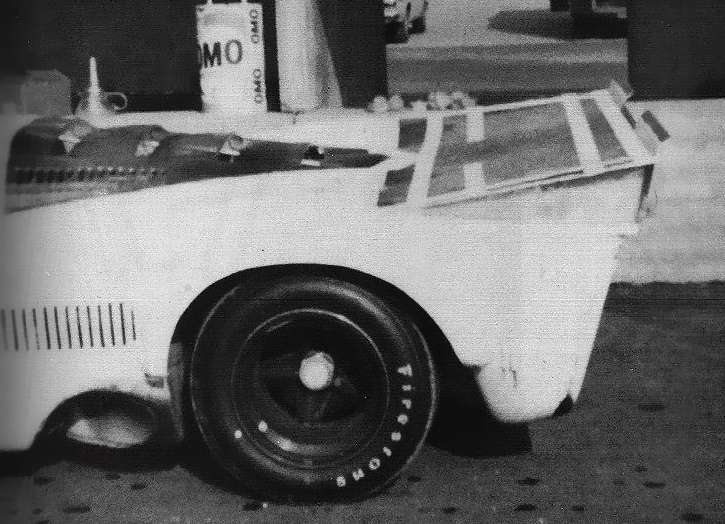
Instead, he says, he noticed that while the fronts and windshields of the test coupes were covered with dead gnats, there were none on the rear spoilers. He concluded that air was not flowing to or over them. Wyer felt so strongly that Horsman had been denied proper credit for the breakthrough that he said in his memoir that the revision should be called "the Horsman Tail,"not named after him and his team. .................
Horsman says in his memoir that he was afraid that his idea would be stopped cold by Porsche's racing management because it was high drag and "Not Invented Here." So, toward the end of the test day, he took pains to casually ask if his mechanics might borrow a coupe and some sheet aluminum. This was the modification Horsman came up with:
|
Tuesday, January 5, 2016
SERA And The Porsche 917, Part Two
Pilotes Anciens: SERA And The Porsche 917, Part Two
Quote:
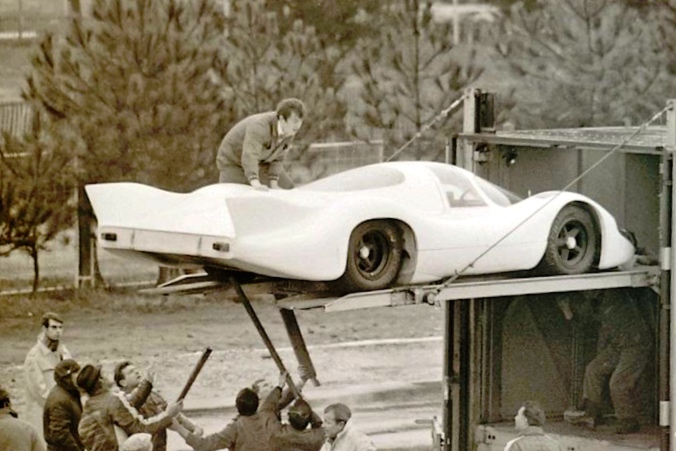
This could be unloading for either of the two Langheck tests at the Volkswagen proving grounds, or for the LeMans
Test Days in April. In any event, the car as seen here is the "first cut" at a 1970 LH. Note the smaller rear window
without louvers. For reasons unrelated to LH aero, 1969's side exhausts for the front cylinders have been lost in
favor of conventional 6-into-2-into-1 exhausts exiting at the rear. SERA was heavily involved in this shape.
|
Click the links above, they explain a lot and better than I have time for.