I think I may have read a mention about this at some point while reading online about Mulholland, but I don't think that it was much more than a brief mention. Based on Jeff Hail's comments in that thread, I've read up a bit on it, mostly what's on wikipedia, although I have some other stuff queued up to read. It was very interesting. The power of mother nature is impressive.
THe interesting thing is that I read about it the other day, and then that evening or the next day my wife said "Let's watch 'Chinatown'" which loosely/fictionally references the people and things involved. I've read a history of the Seattle area called "
Sons of the Profits" (yes, spelled like that), and the story (real and fictional) somewhat reminded me of the vibe from the book.
Now I'm curious to read even more about the St Francis Dam and Mulholland.
Some Amazing stuff.
(excerpts from
https://en.wikipedia.org/wiki/St._Francis_Dam
Quote:
he dam was designed and built between 1924 and 1926 by the Los Angeles Department of Water and Power, then named the Bureau of Water Works and Supply. The department was under the direction of its general manager and chief engineer, William Mulholland.
At 11:57 p.m. on March 12, 1928, the dam catastrophically failed, and the resulting flood took the lives of an estimated 431 people at least.[2][3] The collapse of the St. Francis Dam is considered to be one of the worst American civil engineering disasters of the 20th century and remains the second-greatest loss of life in California's history, after the 1906 San Francisco earthquake and fire.
Given the known height of the flood wave, and that within seventy minutes or less after the collapse the reservoir was virtually empty, the failure must have been sudden and complete. Seconds after it began, little of what had been the dam remained standing, other than the center section and wing wall. The main dam, from west of the center section to the wing wall abutment atop the hillside, broke into several large pieces, and numerous smaller pieces. All of these were washed downstream as 12.4 billion gallons (47 million m³) of water began surging down San Francisquito Canyon. The largest piece, weighing approximately 10,000 tons (9,000 metric tons) was found about three-quarters of a mile (1.2 km) below the dam site.[47]
Five minutes after the collapse, the then 120-foot-high (37 m) flood wave had traveled one and one-half miles (2.4 km) at an average speed of 18 miles per hour (29 km/h), destroying the heavy concrete Powerhouse No. 2 there and taking the lives of 64 of the 67 workmen and their families who lived nearby. This cut power to much of Los Angeles and the San Fernando Valley. It was quickly restored via tie-lines with Southern California Edison Company, but as the floodwater entered the Santa Clara riverbed it overflowed the river's banks, flooding parts of present-day Valencia and Newhall. At about 12:40 a.m. Southern California Edison's two main lines into the city were destroyed by the flooding, re-darkening the areas that had earlier lost power, and spreading the outage to other areas served by Southern California Edison. Nonetheless power to most of the areas not flooded was restored with power from Edison's Long Beach steam electric generating plant.[49]
Near 1:00 a.m. the mass of water, then 55 ft (17 m) high,[50] followed the river bed west and demolished Edison's Saugus substation, cutting power to the entire Santa Clara River Valley and parts of Ventura and Oxnard. At least four miles of the state's main north–south highway was under water and the town of Castaic Junction was being washed away.[51]
The flood entered the Santa Clarita valley at 12 mph (19 km/h). Approximately five miles downstream, near the Ventura–Los Angeles county line, a temporary construction camp the Edison Company had set up for its 150-man crew on the flats of the river bank was hit. In the confusion, Edison personnel had been unable to issue a warning and 84 workers perished.[52]
Shortly before 1:30 a.m., a Santa Clara River Valley telephone operator learned from the Pacific Long Distance Telephone Company that the dam had failed. She called a California Highway Patrol officer, then began calling the homes of those in danger. The CHP officer went from door to door warning residents about the imminent flood. At the same time, a deputy sheriff drove up the river valley, toward the flood, with his siren blaring, until he had to stop at Fillmore.[44]
The flood heavily damaged the towns of Fillmore, Bardsdale, and Santa Paula, before emptying both victims and debris into the Pacific Ocean 54 miles (87 km) downstream south of Ventura at what is now the West Montalvo Oil Field around 5:30 a.m., at which point the wave was almost two miles (3 km) wide and still traveling at 6 mph (9.7 km/h). Bodies were recovered as far south as the Mexican border; many were never found
|
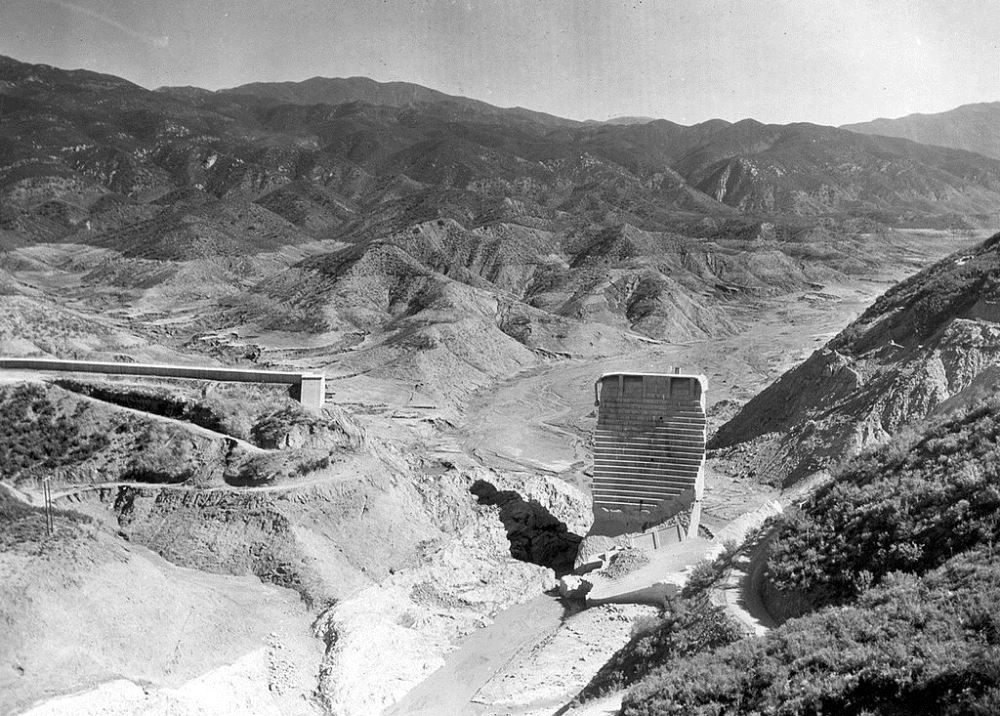
When you consider that there's a person standing on the ground at the bottom right of this photo, wow!

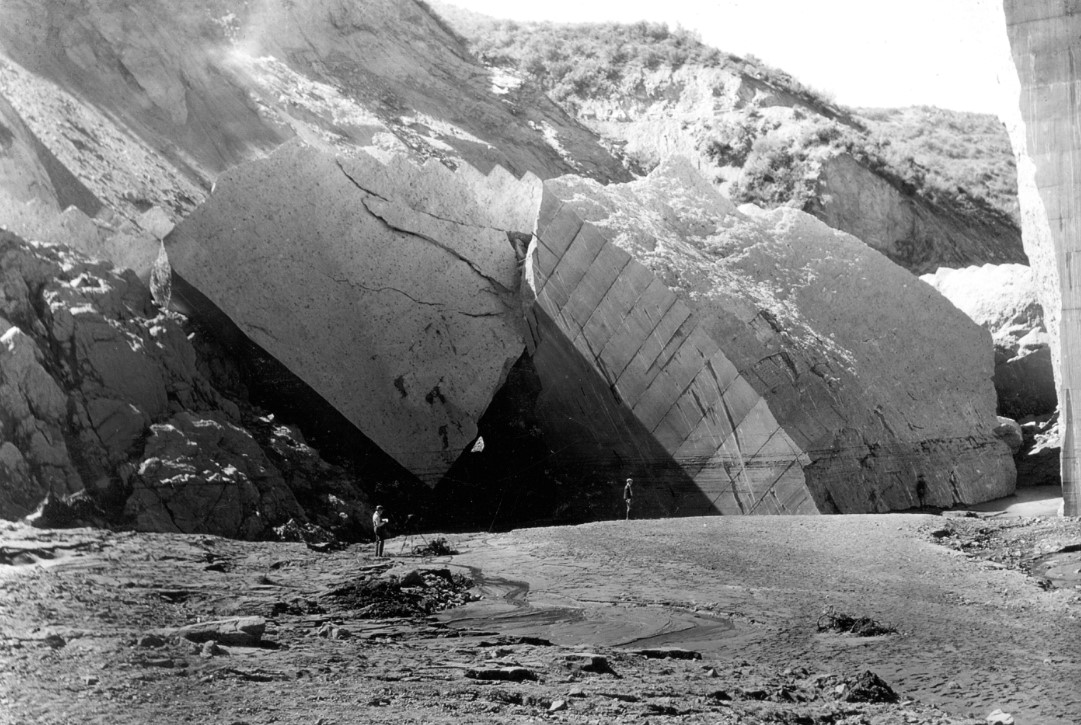
This is the piece that was found 3/4 mile downstream.

Quote:
|
March 15, 1928: A giant piece of concrete from the St. Francis Dam that was carried about three-quarters of a mile downstream dwarfs a man standing at lower right. Los Angeles Times
|
I want to say that I'd read something about that piece of the damn being 30'x50'x60' or something like that, but the only thing that I can find now is the bit on Wikipedia about it weight 10,000
tons.
__________________
Steve
'08 Boxster RS60 Spyder #0099/1960
- never named a car before, but this is Charlotte.
'88 targa

SOLD 2004 - gone but not forgotten