Quote:
Originally Posted by Superman

Steve/masraum sent me a PM and generously offered to help me out. Pelicanheads have made me feel proud for twenty years now, and this is the latest instance. Thank you, Steve.
|
I'm just trying to pay forward the generosity that I've been a recipient of over the years here. I've got a long way to go.
Quote:
|
I think I am using my telescope wrongly, and I wonder if I am focusing on the wrong plane. Flatbutt says stars jumped out of nebula. Eric says my magnification should be around 66/1. Pazuzu says color filters can help. Here's the deal: Color filters will not help me because the image would need to be several times larger in order for me to see anything larger than a spec. If I focus just right on Jupiter, I can see it has moons, but Jupiter itself is still WAY too small for any hope of seeing color details.
|
Seeing color is tough, and when your magnification is still pretty low, even tougher. It's a balancing act. For bright objects like Jupiter, Saturn, and on rare occasions Mars you can see variation in color or brightness. At too low of a magnification, they are too bright (and maybe too small) to see much variation. As you magnify, the brightness goes down, but then at some point, they get too dim to see much color variation.
Quote:
I'm going to return to my original question. Because of some of the comments I see here, I still wonder if I am using this telescope wrongly. The slidey thingie into which the eyepiece is inserted is adjusted so that several inches of the slidey thingie are protruding from the fat part of the telescope.
I was given this telescope about 3 months ago and part of my problem is meteorological. The Pacific Northwest is a wet, cloudy place. This time of year there are several nights per month in which we could not even detect the presence of a full moon, so thick is the cloud cover. No more than a handful of nights per month present any opportunity to see anything. Right now, the National Weather Service says it will rain constantly until at least next weekend.
I do have a nice neighbor with a telescope I have not seen. Perhaps he can coach me. I think I am focusing this telescope wrongly.
|
Yes, it's tough when the weather doesn't cooperate. It's a running joke that when you get new astronomy equipment, it's guaranteed to be cloudy/rainy, and often, the more you spent, the longer the weather will suck.
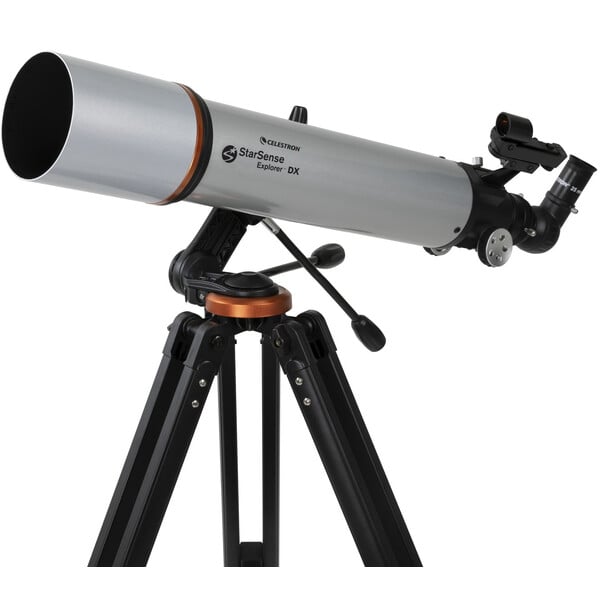
I would assume your scope should look a lot like this.
Here's a generic refractor diagram that lists the major parts

There should be the main OTA (optical tube assembly) which is the tube that's got the objective lens and focuser. Then the diagonal should be inserted into the small end where the focuser is. It's possible to not have a diagonal, but I think that would be a bit unusual. Most refractors like that use a diagonal. Then the EP should be inserted into the diagonal. If you don't have a diagonal, that could certainly cause issues with getting things into focus because the length of the diagonal is part of the optical path. Without it, you may never get things into focus.
You should only have to focus initially, and then if you change eye pieces. Put in your eye piece, find a relatively bright star (but probably not the brightest in the sky) and then focus until the star is a sharp pinpoint. Anything in the sky should then be in focus (since everything in the sky is essentially at infinity).
As far as what you can expect to see of Jupiter when you can get the magnification up there, this is a decent approximation of something that would be a pretty good view. (it's almost impossible to compare photos to what you see with your eyes) On occasional when there is exceptional seeing, you can see more detail

When I've seen the GRS (Great Red Spot), it's usually looked more white. I once saw a hint of pink. Most of the time, when I see it, it looks more like someone took a bit out of the color band that it is embedded in. This photo has a lot of detail which we're pretty unlikely to see, but it has some aspects that to me demonstrate well what I think you would see. The lack of detail on the right hand image (and maybe a bit less, like the small spots wouldn't be detectable) is most closely representative of what I see, mostly just bands of various brightness. I've never seen the GRS look like the image on the right. When I've seen it, it looks more like the image on the left, where there's a dark band, and the spot practically blends in with the light band that it's near. And the dark band looks like someone has taken a bite out of it.

This is reasonably representative of what you can see of saturn. It's mostly just going to be bands of color, and then the "cassini division" (gap in the middle of the rings.

I've seen a view like ^that^ of Mars once, and to see that, I was at 300x magnification and the atmospheric conditions were just right. Mars is a tough subject.
The view of Jupiter in that pic would be decent too if the GRS wasn't actually red. It is possible to see the shadows of Jupiters moons when they cross over Jupiter, but you have to be looking at the right time to see them.
I don't know that you'll ever see color in any nebula.