Quote:
Originally Posted by VenezianBlau 87

If a 20,000 ton displacement ship sinks to xx,000 feet to the sea floor, will it still weigh out at 20,000 tons at that depth? Assume no buoyant compartments or similar conditions.
Thanks,
Bob
|
Based on the bolded portion, I assume you mean, the ship is COMPLETELY flooded with no air pockets, and no materials that would normally float (wood, foam, etc... for instance) You want to know if the weight of the materials is the same.
Quote:
Originally Posted by id10t
Nope. Just increases density of the water - has no effect on the mass of an object or the gravitational pull on it. 33 foot depth of saltwater is about 34 foot of depth of freshwater is about 1atm pressure (14.7psi)
|
Actually, if it's possible to weigh a material at the bottom of the ocean, then because of the relative densities, it would absolutely have a positive (upward) force applied due to bouyancy when submerged in salt water. THere would also be an increased force applied downward (gravity) that is greater than the force applied to the same object at sea level.
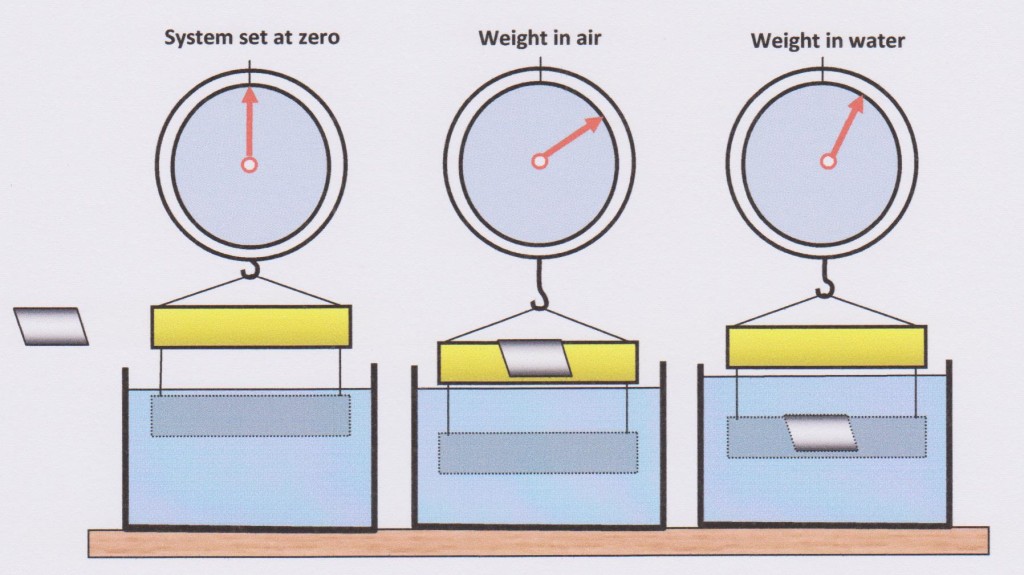
It's that ability to weigh an object under water which enables us to measure the specific gravity (relative density) of substances that can be submerged in water.
Based on the previous information that I found that says that the effect of gravity on an object at the top of Mt Everest is 0.25% less. I'm going to say that the effect of gravity on an object at the bottom of the deepest part of the ocean may be similar but opposite. If you then look at the specific gravity (relative density) of steel, 7.8, then steel submerged in fresh water will only weigh about 87% of what it weighs in air. If submerged in salt water, the weight would be even less. The mass hasn't changed, but there is a force exerted on the object by water which causes it to
weigh (based on a scale of some sort) less.
If you were able to put a ship in dry dock and weigh it, and then you were able to sink it in the ocean, so that it was just barely covered in sea water, and you had a way (no pun intended) to measure the weight of the submerged boat, it would weigh measurably less than the boat in dry dock (assuming completely flooded with no air pockets. That's exactly how specific gravity is measured, by weighing objects before and after being submerged in water. Changing from distilled water to salt water would then make a difference that could be as little as 2.5% or as high at 7% when 10km down.