|
Back in the saddle again
Join Date: Oct 2001
Location: Central TX west of Houston
Posts: 57,135
|
Quote:
Originally Posted by stevej37

Gold wouldn't be attracted to a magnet?
I don't have any gold teeth...but I would ask if I did.
I have a titanium rod in my femur and asked. They said...no problem.
|
It's only a big deal if it's magnetic, I believe.
What's REALLY whacky is that with a big enough magnet, you can float stuff that you wouldn't think was magnetic.
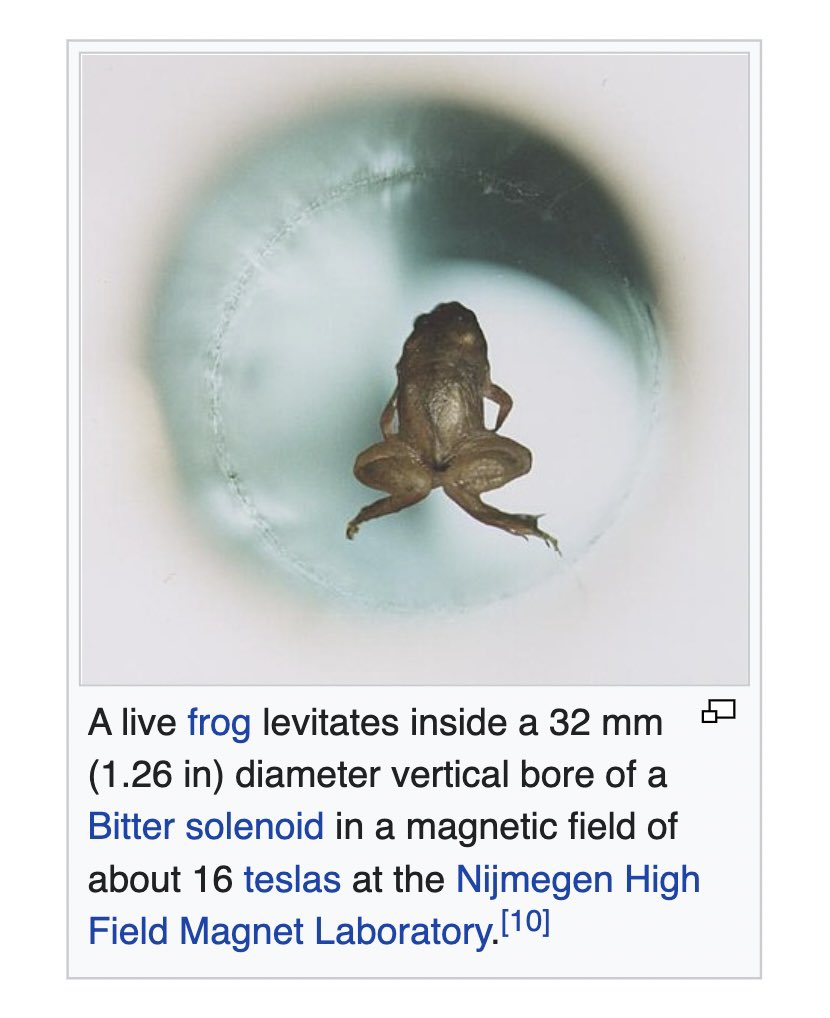
Here's a floating drop of water that is floated using only a magnet.

This was done in 1997.
https://www.science.org/content/article/floating-frogs
Quote:
When pigs fly? That could be sooner than you think. A group of researchers in the Netherlands and in England has made a frog levitate in a magnetic field. Although the feat might seem no more than a curiosity, researchers say that the floating amphibians may lead the way to a cheap alternative to space-based science experiments.
Many materials are diamagnetic--that is, when placed near a magnet, their atoms fight the magnetic field, and the object tries to scoot away. If such a material is placed in a strong enough magnetic field, it levitates. Superconductors, for example, are perfect diamagnets and can levitate over even weak magnets, which is why levitating trains like those in Japan can fly over the tracks. Organic material like living cells is very weakly diamagnetic, says J. C. Maan, a physicist at the University of Nijmegen in the Netherlands. So he and colleagues employed a very strong magnet (chiefly used for crystallography experiments) to float the frog. It took 16 teslas--a very powerful field indeed--to lift the confused amphibian off the ground.
"It's a little surprising how easy it is to do this," says James Brooks, a physicist at the National High Magnetic Field Laboratory in Tallahassee, Florida. "It's not incredibly exotic equipment. Any scientist who is awake will ask `What can I do with this?' " Brooks notes that the magnetic fields might provide a way to study materials in milligravity--without sending them into space--because the levitating object is in a net zero field. Researchers could study the effects of microgravity on crystal growth and also on the growth and development of living cells, without costly space missions.
The frog, although bewildered, was apparently none the worse for wear, with "no physical sign of any malfunction," says Maan. "The idea that you can do this with a biological entity is interesting," says Robert Hollebeek, a physicist at the University of Pennsylvania. "The next question is: `Gee, can we levitate a person?' " The Nijmegen group says that it is, indeed, possible, and is investigating how other living creatures float.
|
__________________
Steve
'08 Boxster RS60 Spyder #0099/1960
- never named a car before, but this is Charlotte.
'88 targa  SOLD 2004 - gone but not forgotten
|
 08-07-2023, 05:29 PM
|
|