Quote:
Originally Posted by vash

People talk about sugar addiction. Never thought much about it. Legit?
|
I think it is a real thing.
I call it the carb rollercoaster, and it is a terrible lifestyle.
https://www.pacehospital.com/roller-coaster-effect-in-diabetes
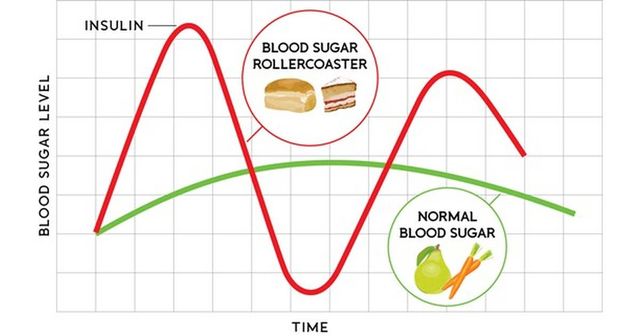
Wheat flour is the common carrier for sugar in processed foods.
If you go on a low gluten diet, you are in essence going on a low sugar diet.
One thing you will find when going gluten free is you will not get crazy hungry like a drug addict needing a fix. You will simply slow down like a child's toy with a drained battery. Hunger pains will be replaced with fatigue, and tiredness will be the signal to eat. Best to avoid draining down too far, and eat something light every three hours or so.
If you are working out vigorously you need about twice as much protein. Natural unprocessed protein stays in your bloodstream only 3-4 hours. Fast acting and processed
protein powders even a much shorter time.
I would not go big on gluten free breads, treats or beer. The main advantage of going low gluten is going low carb, and substituting one carb for another is a lateral change costing you twice as much.
Things would be much easier if our government didn't subsidize all the wrong foods for our health.
November 3, 2021
PRIMER: Agriculture Subsidies and Their Influence on the Composition of U.S. Food Supply and Consumption
Tara O'Neill Hayes, Katerina Kerska
https://www.americanactionforum.org/research/primer-agriculture-subsidies-and-their-influence-on-the-composition-of-u-s-food-supply-and-consumption/
Quote:
Executive Summary
The federal government has long subsidized America’s farmers, significantly affecting our food supply and what we eat.
The most highly subsidized crops—corn, soy, wheat, and rice—are the most abundantly produced and most consumed, often in the form of ultra-processed foods.
Sugar is also highly subsidized in the form of indirect price supports that benefit producers and drive-up prices, yet sugar is also widely overconsumed.
Fruits and vegetables, on the other hand, receive relatively little subsidization—and Americans eat much less produce than recommended.
|