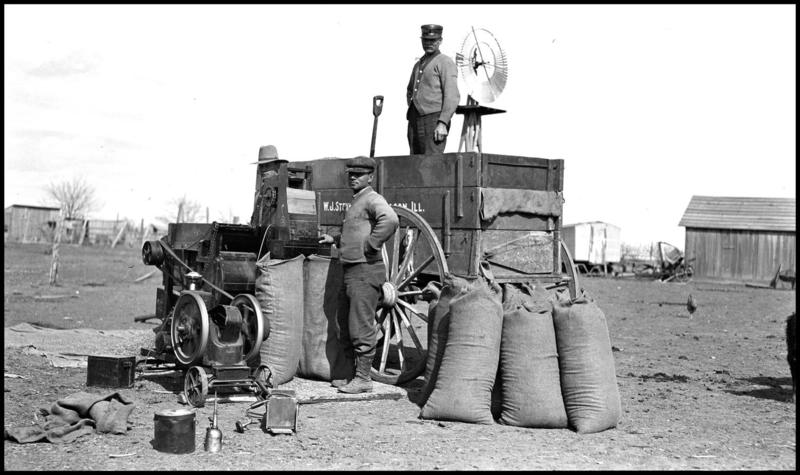
Here's a really cool 1913 photo of men standing in the Panhandle with a fanning mill. What's a fanning mill, you ask?
A fanning mill was one of those ingenious pieces of 19th and early 20th-century farm equipment that did a job every farmer desperately needed done: it cleaned grain. Before you could mill wheat or store oats or plant seed for the next season, you had to separate the good kernels from all the chaff—dust, husks, weed seeds, little bits of straw, and whatever else got swept up during threshing.
A fanning mill did that by using a combination of screens and a hand-cranked fan. You’d dump the threshed grain into the hopper up top, crank the handle, and inside the box a set of sieves would shake back and forth while a wooden or metal fan pushed a steady stream of air through them. The heavy, good grain dropped through the proper screen openings, while the lighter trash got blown out the back or off to the side. In many cases the machines had adjustable screens so you could clean wheat one day, oats the next, and barley the day after that.
Before mechanized threshers became widespread—and later, before combines did the whole job in one pass—a fanning mill was as essential as a plow. They were often hauled out into the yard after harvest, and neighbors sometimes shared them. I think these men are at the grain-cleaning stage of the harvest, knocking the dust out of the crop so it could be bagged up, sold, or kept for seed.