Despite the rapidly approaching Michigan winter, I still “got the fever” and can’t bring myself to put the bikes away. I’m quite comfortable without heated clothing and typically have no issue riding in high 30 degree temperatures. That is, except for my fingers. I’ve tried many different gloves plus combinations of liners and outer shells but still, after about 30 minutes, my digits are destined for disintegration. Heated liners are certainly an option and coupled with my heated grips would probably yield a noticeable improvement. However, a couple friends, thoroughly sold on the improvement handguards made to their machines, encouraged me to take a look at adding them to my S.
As most of you know, there are no guards designed and manufactured specifically for the R1100S. A buddy had no use for an unused pair of guards from an older 1100GS so I began work with these. The challenge?... construct brackets to mount them in a functional location while maintaining full steering travel and avoid contact with body panels.
I’ll spare you the infinite and tedious steps of positioning both guards with cardboard brackets in search of a suitable position. But, during this process I began to think, “If I want REALLY warm hands, why not ensure they are protected from the airflow as much as possible.” That explains the additional parts seen below. These two extra deflectors help to ensure the cold wind flows over the top and around the side of the open guard.
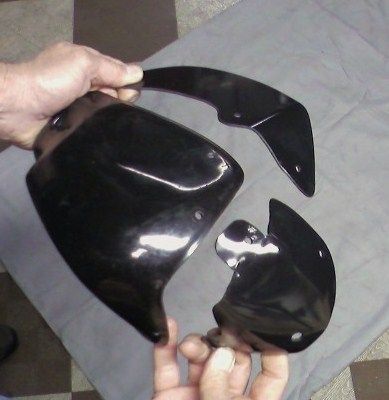
Each deflector began life as a cardboard template. The outline is transferred to a piece of flat, 1/8” thick ABS plastic and cut to shape. All four parts required shaping to fit the original guard, ensure adequate hand coverage and still look good once assembled. The upper deflector for the left side appears below. It required only a simple bend and minor forming at the outboard end.
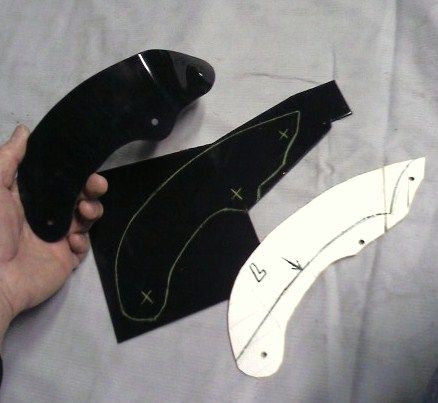
The end deflectors are more complex and required forming over a sphere to produce a cup shape. I’ve heat-formed a myriad of parts over the years and typically use a small propane torch. A fan nozzle spreads heat over a larger area for complex forming or heating a larger area. Once soft, the part can be shaped by hand with protective gloves or smoothed over a rigid mandrill or object. A needle nozzle yields a flame for small, precise work; or if you need to soften a narrow strip for a simple bend.
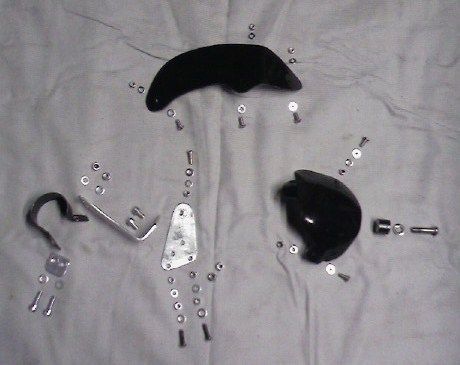
In addition to the new ABS deflectors, each guard also requires three custom fabricated metal parts; (2) brackets and (1) plate - all made from aluminum. The black bracket seen below clamps around the top of the fork tube and is lined with a 1.0 mm thick strip of protective vinyl so as not to scratch the tube.
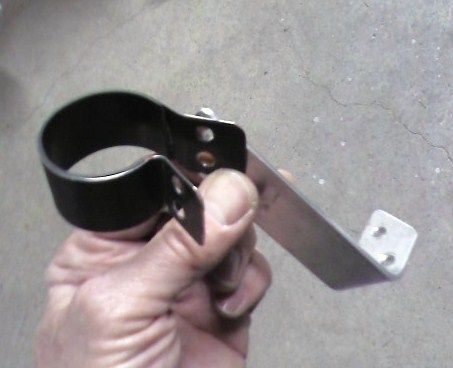
The longer aluminum bracket was made from 1/8” thick by 1” wide strip stock. Each hanguard bolts to this bracket. Because the size and shape of both brake and clutch master cylinders are different, specific non-symetrical brackets and plates were fabricated for each hand.
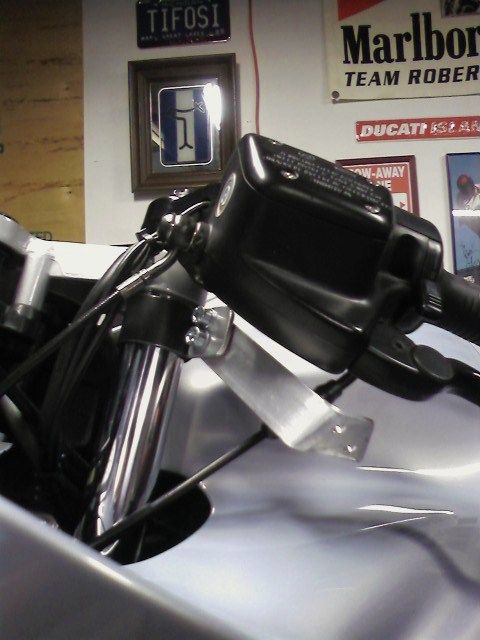
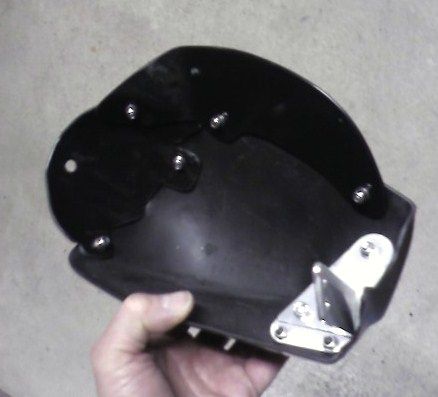
Here’s the inside of the left guard with both additional ABS deflectors bolted in place. The triangle shaped plate, (again, fabbed from 1/8” aluminum) attaches to the plastic guard through existing holes.
This exploded view illustrates all the parts I needed to fabricate or obtain for the LH guard. 5.0 x 0.75 mm dome head bolts were used for a clean, smooth appearance with appropriate washers and nylock nuts - all stainless steel. This same collection of parts was duplicated for the RH guard assembly.
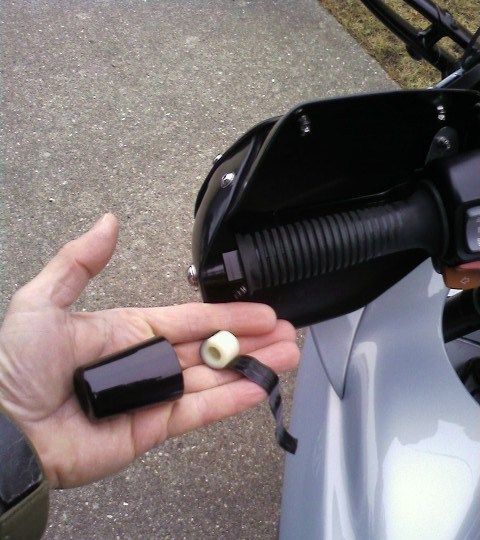
The cardboard design/mock-up phase indicated I would need a thick spacer between the inside of the guard and the end of the clip-on. (3) ¼” thick nylon washers fastened together with black electrical tape quickly create and conceal this simple spacer. The stock bar ends were not retained for this installation but will be re-installed in the Spring when the handguards are removed.
So, was it worth the effort? Absolutely… these things REALLY work! In upper 30 degree temps for nearly 2 hours, cruising at 50 to 80 mph, I have no issue with my fingers…especially coupled with the heated grips. Moreover, once installed, there’s about 5 mm clearance to each turn signal bezel and side fairing at full steering lock; left or right.
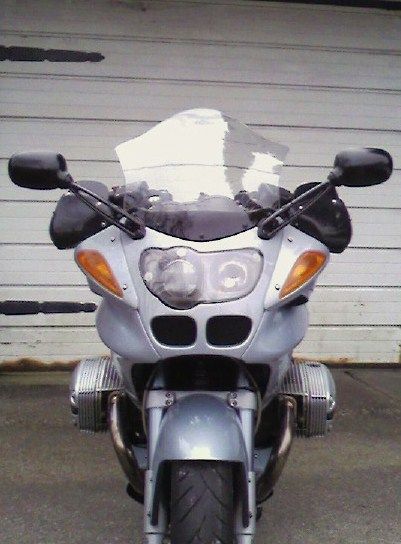
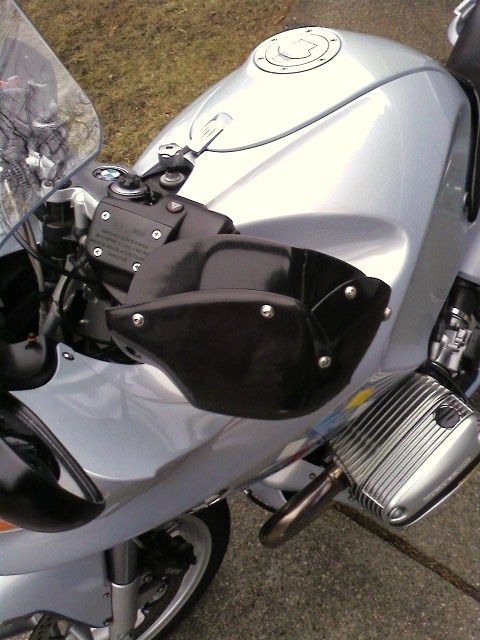
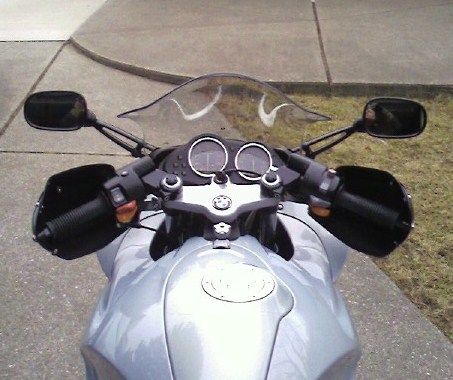
Soon, when winter arrives in full force, the bikes must enter hibernation. But until then, these modified handguards have opened my comfortable riding window just a bit further. I’m glad I took the time to fabricate all the parts and fit them to my “S”.
Ride safe.
Pete.
ps. Granted, these photos are not of exceptional quality but I hoped to include many more documenting the project. Sadly, I did not realize (10) photos is the maximum limit per post. I can include other appropriate photos in any reply's that may arise.