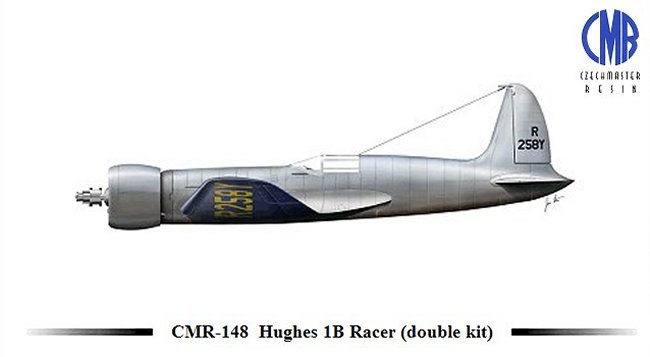
Czech Master Resin 1/72 Hughes 1B Racer (double kit) model kit
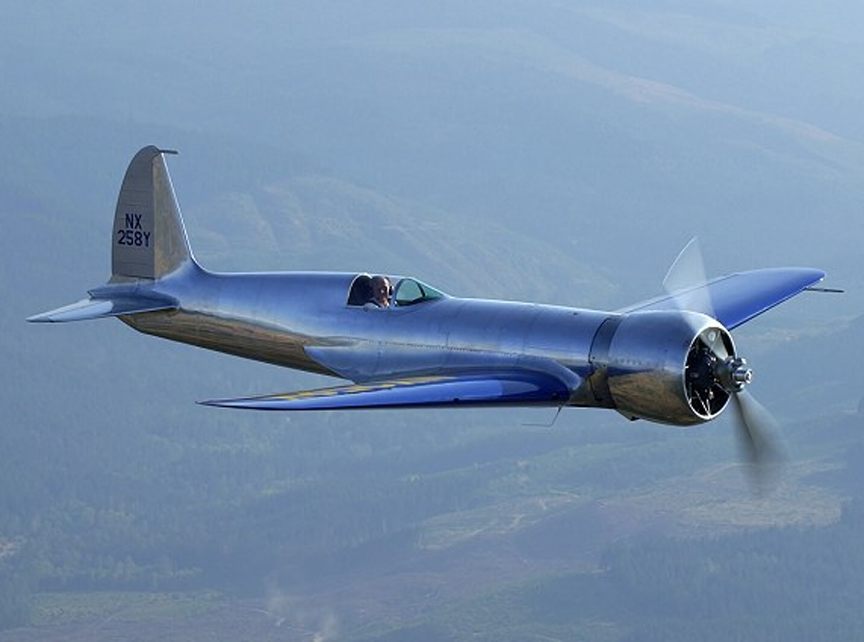
 Photos: Hughes H-1B (Replica) Aircraft Pictures | Airliners.net
 Model Airplane News Cover for January, 1936
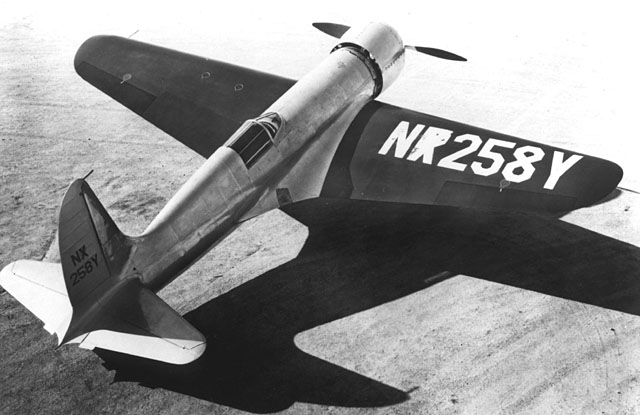
 Hughes H-1 Racer - Wikipedia, the free encyclopedia

Quote:
Considering the contemporary service aircraft were biplanes, Hughes fully 300px-Hughes_racer_(brightened).jpgexpected the United States Army Air Corps (USAAC) to embrace his aircraft's new design and make the H-1 the basis for a new generation of U.S. fighter aircraft. His efforts to "sell" the design were unsuccessful. In postwar testimony before the Senate, Hughes indicated that resistance to the innovative design was the basis for the USAAC rejection of the H-1: "I tried to sell that airplane to the Army but they turned it down because at that time the Army did not think a cantilever monoplane was proper for a pursuit ship..."[7]
Aviation historians have posited that the H-1 Racer may have inspired later radial engine fighters such as the Republic P-47 Thunderbolt and the Focke-Wulf Fw 190.[8] After the war, Hughes further claimed that "it was quite apparent to everyone that the Japanese Zero fighter had been copied from the Hughes H-1 Racer." He noted both the wing shape, the tail design and the general similarity of the Zero and his racer.[9][N 2] Jiro Horikoshi, designer of the Mitsubishi Zero strongly denied the allegation of the Hughes H-1 influencing the design of the Japanese fighter aircraft.[10]
The Hughes H-1 Racer is featured in the 1940 RKO Radio Pictures movie: Men Against the Sky.[11]
|
Makes you wonder what kind of a fighter this would have made, perhaps a smaller target than the ME-109 (and the much later FW-190)?
EDIT: a disscussion on that topic:
http://www.ww2aircraft.net/forum/aviation/if-hughes-h-1-would-have-been-made-into-fighter-22708.html
Quote:
Shortround6
I am not sure anybody succeeded in turning a race plane INTO a fighter.
The Hughes used two different wings, one short one for speed and one long for the distance flight.
|
The aspect ratio of these wings tell me it could not make higher altitudes, reminds me of some of the Russian fighters more than the Zero.
http://www.fiddlersgreen.net/models/aircraft/Hughes-H1.html
Quote:
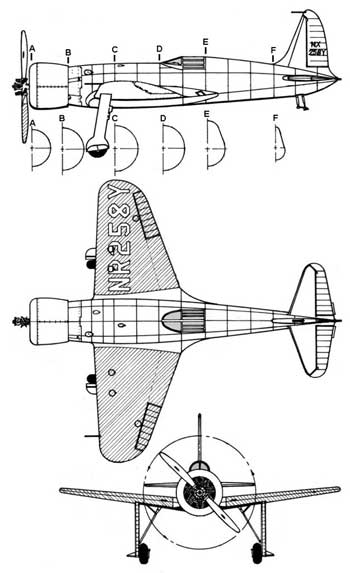
Length: 27 ft
Wingspan: 31 ft 9 in
Height: 8 ft
Wing area: 138 ft²
Empty weight: 3,565 lb Loaded weight: 5,492 lb Powerplant: 1× Pratt &
Whitney R-1535 radial engine, 700 hp
Performance
Maximum speed: 352 mph Wing loading: 40 lb/ft² Power/mass: 0.13 hp/lb
|
Maybe that drawing is not very accurate, or perhaps the H1 and 1B wings were quite different from each other.
Altitude would not be a problem after all I suspect.
http://acepilots.com/pioneer/hughes.html
Quote:
|
The Hughes H-1 influenced the design of high-performance aircraft for many years, with features such as:a close fitting engine cowling to reduce drag and improve cooling; aerodynamic wing fillets to stabilize airflow; retractable landing gear to reduce drag; flush rivets and joints; flat, counter-sunk screws on the plywood wings; ailerons designed to droop for better lift on take-off; a smoothly faired and enclosed cockpit; and an adjustable canopy windscreen for easy access. Radial engine World War II fighters including the F6F Hellcat, the P-47 Thunderbolt, and the German FW 190 all incorporated design advances pioneered by the H-1.
|