Quote:
Originally Posted by torontoworker

Absolutely NOT true. The hot spots in cly's that causes failure modes has been found to have many causes, one major one being debris in coolant channels or poor casting issues. It has not been caused by someone using an OEM factory spec thermostat. If this were true EVERYONE with a factory OEM part would be sitting parked now including my high mileage STOCK 1999.
The temperature levels that your engine thermostat opens up at are designed this way for specific reasons due matching the features of the car/engine such as if you have three rad's or are using a Tip or PDK etc. The engines all have a temperature specification that the coolant has to be at (within a + or -) and this relates to emissions and other engine related reasons.
The 'belief' that lowering the coolant temperatures is *always* better is urban myth and 1980's thinking when talking about a well maintained engine with modern ECM's control units. Over cooling an engine (out of Porsche spec's) is a sure fire way to set off a CEL or damage the engine in the long term. There are good reasons for factory operating specifications for normal use vehicles.
|
Sorry, but you are incorrect. The cylinder head cracking issue stems from the design of the head which features several restrictive passage's (easily seen if you have ever cut one apart). While debris from issues such as water pump wear do exacerbate the flow restriction further, the major fault is in the severe thermal loading on the castings that take place during normal engine operations, when some of these areas can be as much as 40F (or more) hotter than the general coolant temperature, and significantly hotter than the adjacent casting areas, which has been observed by more than one shop. With the OEM stat just beginning to open at 186F, and not being fully open until the coolant is well in excess of 205F, thermal imaging of the cylinder heads shows some pretty staggering heat differentials between these restricted areas and the adjacent castings, even on brand new heads on a brand new engine, where there is no chance of debris blockage. And coincidentally, these areas of high heat concentration are were many of the castings crack:
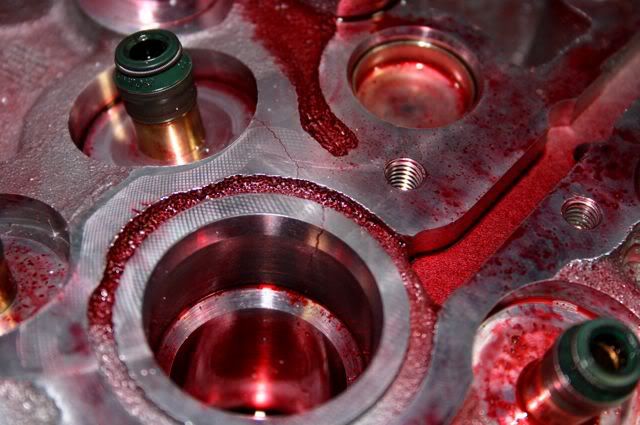
Switching to a low temperature stat not only dramatically lowers the overall coolant temperature, but it also equally dramatically lowers the temperatures of the known hot spots in these heads, and brings them closer to that of the adjacent casting areas, reducing the physical stress on the castings caused by the otherwise high thermal loadings.
As for a low temperature stat causing a CEL, that is complete nonsense. With literally hundreds of customers running one, some for nearly a decade, I have never seen a CEL that could be attributed to lowering the coolant temperatures. Add in the reams of UOA's collected over the years on the cars running the low temperature stats, and you notice that the oil in the engines with the lower coolant temperatures holds up longer (stays in grade) without any signs of increased water or fuel intrusion. The improvement in oil longevity has also be born out when we have had the opportunity to check the rod and crank bearings on engines that had run the 160F stat for long periods of time, both on the street and the track. And just as a by-the-by, Porsche uses the same type of low temperature stats as OEM components in their highest performance engines, the ones found in the GT2, GT3, and Turbo cars