I had previously buffed out the blower motor's commutator surface with a length of stiff eraser, carefully cleaned out the mica spacers between the commutator segments with the blunt edge of an Exacto-knife and blew everything out with compressed air. The depth of the mica indicated that there was lots of life left in this motor so I had decided to take the trouble of installing some new brushes and lube the bearings. Since the armature sits vertically I added a little light oil and then a dab of STP to the upper bearing recess and using a thin plastic straw temporarily stuck between the blower fan blades - a little lube was also applied to the felt around the lower bearing. It ran as quiet as a church mouse when powered up prior to re-installation.
After trying to find a couple of new brushes for the blower motor I finally had to make my own. Evidently most alternator/starter rebuild shops do not carry much in the way of parts any more - especially when it comes to individual metric sized stuff. One shop did find a dusty twin lead starter brush that I could make work. Although it was about the correct thickness, it was twice as wide as I needed. Since it had a copper lead attached to the top of each end all I had to do was cut it in half, square it up a bit, contour the commutator contact end and I'd be in business.

I used a fine tooth hack saw blade and miter box as a guide to divide the starter brush down the middle. Then a medium size flat file took off the extra width until I had two correctly sized replacement blower motor brushes. The corner edges and the contoured commutator end of each new brush was closely approximated by comparing the old brushes. Only a few final touches were needed while sliding the new brushes through the brush boxes to make sure there were no binding issues. Since I knew that the copper leads were not quite long enough to reach the original brush terminal posts I had cut the old brushes off at the brush end leaving the majority of their electrical leads in place. With the new brushes installed in their brush boxes, each (new and old pigtail) end of the two copper leads were both joined together in a short uninsulated barrel splice and crimped. I then soldered the leads within the splice for good measure. The photo of the commutator surface didn't come out too clear.
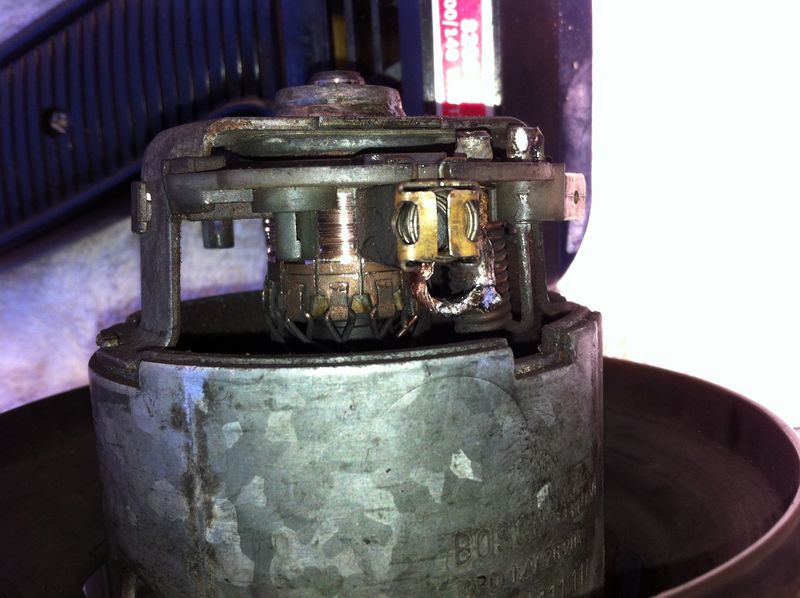
Hopefully my blower motor rebuild effort will last a while. Once everything was buttoned back up and working better than new, I figured that in saving a few dollars in parts, it had only cost me about $2,000 in labor and heart burn......

Michael