

|
|
|
|
| Author |
|
|
Registered
Join Date: Mar 2004
Location: Higgs Field
Posts: 22,771
|
Quote:
Funny thing, though, about .45-70 loads in these modern times. The Marlin "1895", as produced today, really isn't. It's a 336, modified to accept the .45-70. To a degree, anyway. You see, the 336 is really a ".30-30 sized" action and, as such, is far too short for full length .45-70 rounds, like the ones the old Trapdoor Springfields, 1874 Sharps, Remington Rolling Blocks, and other such rifles will accept. The original Marlin 1895 was a full length action, like the Winchester 1886, and would accept full length rounds. It was discontinued in the early 20th century. The modern "1895" is nothing at all like it. What this has done is it has engendered a modern "short" .45-70. There is a whole niche industry now built around modern Marlin 1895 length .45-70's. The BFR is a part of that - the cylinder, as long as it is, only accepts "Marlin length" rounds. As such, seating 500 grain or heavier bullets really, really eats up powder capacity. Here is a comparison of the difference I'm trying to explain. On the left is my "Marlin load", the 400 grain RCBS bullet with gas check. On the right is a 540 grain Paul Jones "Creedmoor" bullet in a black powder match load. The former cycles through the modern 1895, the latter will not. It will, however, cycle through original 1895's and 1886's, plus it will chamber in any single shot. If I were to seat that bullet deep enough to fit the Marlin, you can see how much powder capacity it would be giving up. That's where the BFR is at as well - it will accept "Marlin" loads only. Kind of a quandary, really. But, like I said, I would still go for the weight anyway. 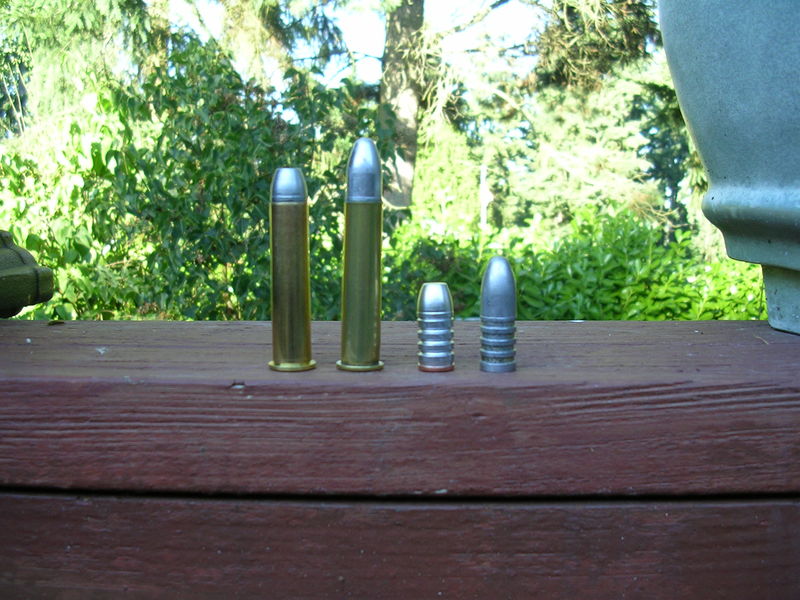
__________________
Jeff '72 911T 3.0 MFI '93 Ducati 900 Super Sport "God invented whiskey so the Irish wouldn't rule the world" |
||
 07-26-2020, 07:03 PM
|
|


