

|
|
|
|
| Author |
|
|
Registered
|
Center support staircase advice please
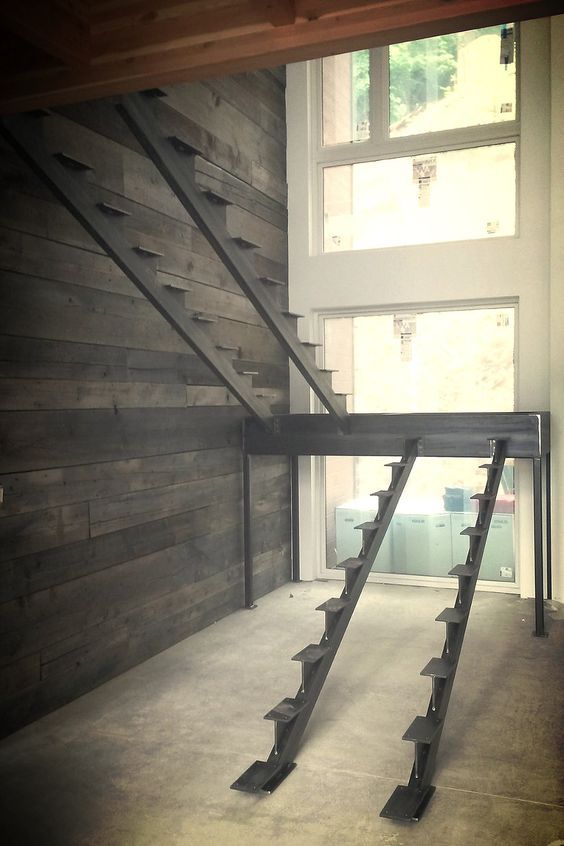
Needing some engineering advice on a center spine single story staircase for new inside construction.
Each tread will be made of oak 2 inches thick, 11 deep , and 38 wide. The treads fasten to a steel structure. So, there will be full width fastener locations to p and bottom. We want to have a clear span from bottom to top. ( floor to ceiling windows behind it) So how thick should each tread steel platform should be? How wide and deep should the sawtooth steel center spine be?of course hand rails need to be installed We want it rigid enough so there isn't the vibrations that come from thinner structures Thanks |
||
 11-25-2018, 09:11 PM
|
|
|
Information Junky

Join Date: Mar 2001
Location: an island, upper left coast, USA
Posts: 73,167
|
"We want it rigid enough so there isn't the vibrations that come from thinner structures"
That's not the most refined spec there. Perhaps find a spiral stair case that you like and copy it. ...or ping it with a hammer, record the note, tell an engineer that's the spec. D-flat, or whatever. Just saying, everything has a natural frequency.
__________________
Everyone you meet knows something you don't. - - - and a whole bunch of crap that is wrong. Disclaimer: the above was 2¢ worth. More information is available as my professional opinion, which is provided for an exorbitant fee. 
|
||
|
11-25-2018, 10:01 PM
|
|
|
Information Junky
Join Date: Mar 2001
Location: an island, upper left coast, USA
Posts: 73,167
|
Here's a nice straight-forward breakdown. Note only the cantilever part.
http://www.vibrationdata.com/tutorials2/beam.pdf
__________________
Everyone you meet knows something you don't. - - - and a whole bunch of crap that is wrong. Disclaimer: the above was 2¢ worth. More information is available as my professional opinion, which is provided for an exorbitant fee.
|
||
|
11-25-2018, 10:06 PM
|
|
|
Information Junky
Join Date: Mar 2001
Location: an island, upper left coast, USA
Posts: 73,167
|
Oh, and for steels, the "E" (modulus of elasticity) is typically 30Mpsi.
The "I" is moment of inertia. Angle of flat stock? ...so many choices. :-/ IOW, just copy something you like. 
__________________
Everyone you meet knows something you don't. - - - and a whole bunch of crap that is wrong. Disclaimer: the above was 2¢ worth. More information is available as my professional opinion, which is provided for an exorbitant fee.
|
||
|
11-25-2018, 10:17 PM
|
|
|
Registered
Join Date: Mar 2004
Location: Los Angeles
Posts: 17,699
|
Dave,
You only want one stringer (saw tooth) out of steel and the thread is cantilevered on both side made of 2" Oak? I am not sure if you can get around the vibration part unless its way over build, but that will look too bulky. I am not an engineer so take that with a grain of salt. I bet if the stringer is made nice and thick with a flange 24" in each direction a lot of the vibration will be eliminated. The problem is getting your building official to Ok this because they will need to see the engineer's stamp and approval. Jeff |
||
|
11-25-2018, 10:57 PM
|
|
|
Cogito Ergo Sum
|
I’ve got no advice, but sounds like a cool project! Post pics when done if you can!
|
||
|
11-25-2018, 11:14 PM
|
|

|
|
Registered
Join Date: Mar 2004
Location: Los Angeles
Posts: 17,699
|
The trick is to not have any steel showing on the thread. I have grooved the underside of the thread to accept heavy flanges (3/4" thick x 2" wide that goes into these grooves) welded to a 1/2" thick plate the threads sit on for additional support. A space is routed out to accept this plate so looking at the thread, there's no steel showing Trouble is, this is visible from the underside should you look up. It was painted to match the wood as close as possible instead of black.
This was for a completely different support system on this funky staircase. It has only four steps and the support came out of the wall. Last edited by look 171; 11-26-2018 at 01:38 AM.. |
||
|
11-26-2018, 01:35 AM
|
|
|
Registered

|
A couple of decades ago I did something similar. Unfortunately I don't have any pictures. If I remember correctly we used round pipe and had it bent to the correct radius and then welded the tread brackets to it. It was stunning when finished.
__________________
2012 987 Cayman S Black Edition #110 1996 993tt Arena Red (Sold) 1996 993tt Black (Lost it in a bluff game) 1975 911 Hardtop Targa(sold) 1971 911T Coupe (Sold) |
||
|
11-26-2018, 06:10 AM
|
|
|
Registered
Join Date: Apr 2005
Location: outta here
Posts: 54,918
|
You don't specify whether or not you will have risers in addition to the treads. If so, they will add considerable stiffness to the stairs. Rather than make the center support out of plate, I would suggest you make it in a box section. The wider and deeper, the better. If it contains internal bulkheads, so much the better. I would use a structural adhesive on any mechanically fastened connection. You can also use the railing on both sides to substantially stiffen the structure, depending on how it's constructed.
I don't know if you are building this in a permitted project, you might consider getting an engineers stamp on whatever design you come up with. |
||
|
11-26-2018, 06:40 AM
|
|
|
I see you

Join Date: Nov 2002
Location: NJ
Posts: 30,123
|
Quote:
__________________
Si non potes inimicum tuum vincere, habeas eum amicum and ride a big blue trike. "'Bipartisan' usually means that a larger-than-usual deception is being carried out." |
||
|
11-26-2018, 06:47 AM
|
|
|
Registered

|
Quote:
Right now nobody has any idea how all the parts fit together because it has not been drawn. Plan view, elevations, sections and details in addition to any 3D sketches showing intent are necessary. What you started out describing sounded a lot like what is built in Europe, our building codes will not allow for such artistry. My feeling on this is you are perhaps building this in an earthquake zone, which means all bets are off. You better hire a structural engineer TRE Cup. Recent Earthquakes Near Van Nuys, California, United States https://earthquaketrack.com/us-ca-van-nuys/recent Quote:
__________________
1977 911S Targa 2.7L (CIS) Silver/Black 2012 Infiniti G37X Coupe (AWD) 3.7L Black on Black 1989 modified Scat II HP Hovercraft George, Architect |
||
|
11-26-2018, 07:19 AM
|
|
|
Registered

Join Date: Jan 2002
Location: Long Beach CA, the sewer by the sea.
Posts: 38,228
|
Quote:
We need to start here. |
||
|
11-26-2018, 08:48 AM
|
|
|
Registered
Join Date: Aug 2015
Location: Pacific Northwest
Posts: 2,479
|
Are you trying to do something like this
|
||
|
11-26-2018, 09:05 AM
|
|
|
Registered
Join Date: Mar 2004
Location: Los Angeles
Posts: 17,699
|
Quote:
|
||
|
11-26-2018, 09:05 AM
|
|
|
Registered
Join Date: Aug 2015
Location: Pacific Northwest
Posts: 2,479
|
another one

|
||
|
11-26-2018, 09:08 AM
|
|
|
Registered
Join Date: Aug 2015
Location: Pacific Northwest
Posts: 2,479
|
And another

|
||
|
11-26-2018, 09:11 AM
|
|
|
Registered
Join Date: Aug 2015
Location: Pacific Northwest
Posts: 2,479
|
Hope these help

|
||
|
11-26-2018, 09:17 AM
|
|
|
Registered
Join Date: Aug 2015
Location: Pacific Northwest
Posts: 2,479
|

|
||
|
11-26-2018, 09:25 AM
|
|
|
Registered
|
Quote:
Good idea to crack open the code book and see if any of these meet code. Thinking 4-inch sphere above, and 6-inch sphere in triangle at the bottom especially, and of course you have to have a grabrail/handrail on at least one side (commercial is both sides). FYI: IRC 2015 changed/lowered residential riser max. ht., many older designs will need to be modified for more run length and an added riser. Just a head's up. The engineering for a one-off can be intimidating. I suggest going with a manufacture that carries an engineer's seal on their deigns, then all you do is add the treads and hope you pass inspection. Some jurisdictions will bust your balls, other's just want a piece of paper in their files with a seal on it relieving them of liability. Every project has a different bar set for it, life is not fair. You will need the connections top, middle (if there is a landing) and bottom equally engineered to take these point loads. Might end up with more than one engineer's seal.
__________________
1977 911S Targa 2.7L (CIS) Silver/Black 2012 Infiniti G37X Coupe (AWD) 3.7L Black on Black 1989 modified Scat II HP Hovercraft George, Architect Last edited by kach22i; 11-26-2018 at 09:40 AM.. |
||
|
11-26-2018, 09:29 AM
|
|
|
Registered

Join Date: Nov 2000
Location: AZ
Posts: 8,414
|
Quote:
On the ones I've seen, the platforms that the treads attach to are relatively small, which is likely on purpose to help achieve the "floating plank" effect. I can't help with the engineering aspect, but I do know there are several modular and/or pre-fab kits available out there. You might look into going that route, as all of the engineering has been worked out and install is DIY-able. Regarding vibrations, it's probably going to be a challenge to completely eliminate the hollow ringing/tuning-fork effect of that type of design (solid wooden planks attached to a steel box-beam, etc.) when in use. Anything you could use to isolate the planks from the beam would probably be a no-go. I've used an acoustic (sound-deadening) latex paint additive in the past on other applications that has worked well, so maybe that is an option for coating the beam with. Or, you might look into a pre-fab/engineered wooden center beam. Also, if you haven't sourced the treads already, you might consider going a bit thicker than 2" planks. YMMV. 
|
||
|
11-26-2018, 12:32 PM
|
|


 1986 Porsche 944 2.5l
 hardtop targa slant nose
 993tt
993tt 1996 Porsche 993tt
 1971 Porsche 911t
 2012 Porsche 987 Cayman S
 1977 Porsche 911S 2.7L
