

|
|
|
|
| Author |
|
|
Registered

|
THE PERFECT ENTRY-LEVEL PORSCHE - article
THE PERFECT ENTRY-LEVEL PORSCHE
Pablo Deferrari Friday, July 31, 2015 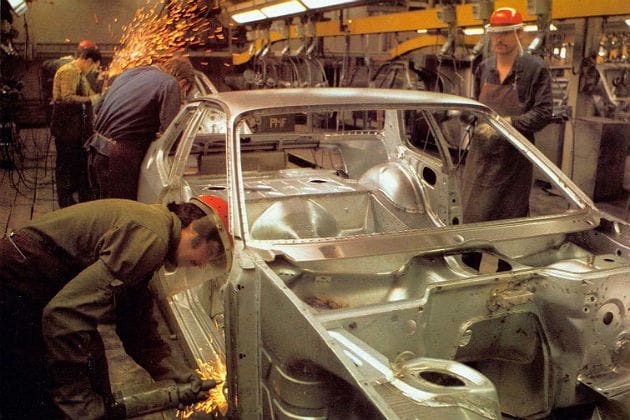 A revolutionary creation from the house of Porsche is about to challenge the way you think about the Marque. It repeats history by following the principles Porsche was founded on - it also redefines them. Provocative by nature, it shocks purists yet invites them with its benevolent appearance and familiar charm. How it seamlessly blends efficiency and performance is a work of art; that its economical nature belies such sporting pedigree is a work of genius. So, what exactly is it? "I wanted to design a car young people could afford." Dr. Ferry Porsche's concept wasn't as simple as it seemed. To fulfill this abstract, Porsche was to create a car that's inexpensive to manufacture, economical to service, maintain and run without compromising on the pleasures of ownership or driving experience. The outcome was to bring a new kind of clientele into the family that starts off with this entry-level car and eventually explores Porsche's more exclusive models. The criterion was simple. This sports car would be small, light and energy efficient - precisely what Ferry had in mind when creating 356/1 in 1948. It would also be far more refined, possessing predictable manners that pleasantly surprises the more experienced while flattering those less so. Practicality, durability and reliability are a given. Like its forbear, it would hum to the beat of four cylinders. The exterior design would be timeless - not exactly breath-taking at first gaze, but certainly an aesthetic promising to look fresh and transcend fads. Configured as a 2+2, the commodious interior and generous amount of luggage space defies the stereotypes of sporting cars as we know them. The break in tradition lies under the skin. The cylinders would be in-line, water-cooled and live at the front of the car, separated from the gearbox that lives at the opposite end. This configuration makes for near-perfect weight distribution between the front and rear of the car, 52 percent and 48 percent, respectively. The engine and gearbox are connected by a rigid torque tube that houses the driveshaft and forms the spine of the car, adding strength to the chassis - a benefit in the event of a front- or rear-end shunt. This tidy drivetrain package simplified the manufacturing process, too. Once subframes, suspension pieces and other assemblies were attached to it, the entire unit could be bolted directly to the chassis. Wherever possible, components made by Volkswagen and Audi are used. This strategy has proven itself in the past, and although those who have conveniently forgotten this bit of history may scoff at the notion, by no means does it detract from the car's pedigree. At first glance, the resemblance to its ancestors is subtle. The swoop of the tail, a nose without an opening, a smooth body unspoilt by frivolous bits and aggressive aerodynamic aids, the gentle curves of the sides that elegantly disappear as the eye follows them downward. There's no mistaking whence it came. 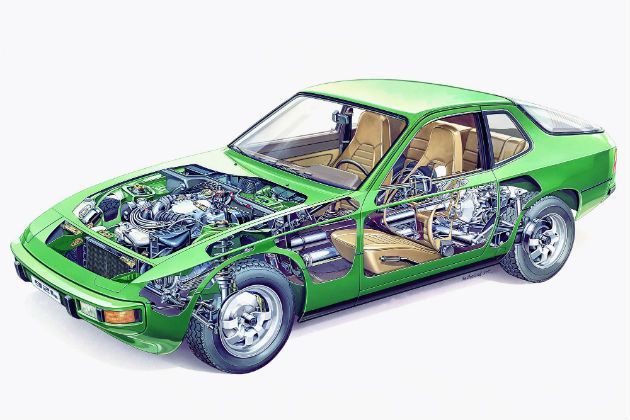 Its wind-tunnel-perfected shape promises low drag and wind resistance. The sloping hood and subtle chin spoiler ensure that the front gets sucked to the ground at speed as it quietly cuts through air that rolls off the raised tail. With its well-distributed mass, low weight and hunkered-down stance, cross winds and high speeds do little to disturb its stability. Moving in, you sit low. The 911-type seats embrace your form, promising comfort in a journey and firmness in a spirited jaunt. Everything you need is within reach. The gearlever is a wrist's flick away from the low-slung steering wheel, while the pedals hang directly in front of your feet. Looking over your shoulder, you realize the potential amount of space available with the seats folded down - you and your significant other could lie down back there and stare at the stars. Did Zuffenhausen's designers subliminally encourage romance? Oil pressure, clock and voltmeter placed directly above the gearshift lend an air of racing pedigree. The speedometer's a comfortable glance down. To its left lies a combination of fuel and temperature gauges flanked by warning lights, and on its right is the tachometer with its eccentrically placed increments putting redline directly top and center. If the conical covers over the gauges seem like a stylistic move, they're not - they were designed to reduce glare. Not a single element in the cockpit escapes Porsche's attention to detail. Everything has a purpose. Porsche does have a whimsical side, however, and nothing demonstrates this more than the colors it chose to clothe this pragmatic goodness. Shades from the primary color chart like green, blue, red and yellow give this Porsche a cheery persona, while others like black, brown, white and metallics accentuate its sophistication. Some of the interior fabrics paying homage to Op-Art, Berbers and Tartans proclaim its individuality and further separate it from the humdrum. Design and engineering are but two of the qualities that Zuffenhausen infuses on this little wedge, and it's the end result that proves this Porsche's mettle. To better understand just how good the performance of this little car is, a comparison with a contemporary 911 is in order. You'll wonder how Porsche has managed to do so much with so little. -Its top speed is a mere 5 mph short of the 911. -It's a nip more than one second slower from naught to 62 mph and lagged 2.3 seconds behind in the quarter-mile dash. -On contemporary tires, it pulled 0.87g of lateral acceleration on a skidpad, exactly the same as the 911. -Despite having two fewer cylinders, being short 700cc, and down 40 horsepower and 55 pound-feet of torque, it can still give the 911 a run for its money. -Even more impressive is its ability to sip fuel. During city driving it gets 17-20 mpg, 42 mpg at a steady 56 mph, while the lead-footed will be pleasantly surprised to see it can achieve nearly 35 mpg at 75 mph. 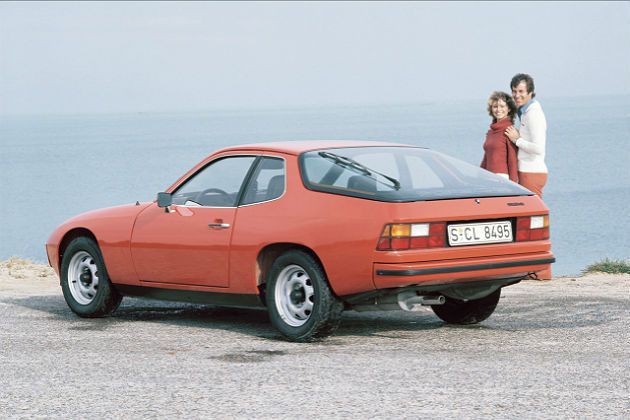 The media reports helped to further bolster its image swaying the undecided and the skeptics alike in its favor. In an issue of Motor Trend, one journalist was impressed by the solid feel of the shifter, praising the gear changes, describing them as positive and sure. He commented on its excellent and neutral handling when pushed hard around curves, and how its acceleration is deceptively strong "moving out quicker than you think," easing into higher speeds, where it feels relaxed. The car had him sold. Autoweek observed how its smart colors and shape "easily stopped traffic wherever the car was taken, from Sunset Boulevard to Big Sur." A few groaned about the harsh ride that took sinkholes in stride but twitched rolling over a pebble. In its defense, Michael Jordan, in an issue of Car and Driver, acknowledged this reaction but offered how the "harsh ride disappeared and became a tenacious roadholding." What may be considered perhaps the ultimate trial and testament of this Porsche's pedigree came with three grueling journeys across the globe. The first, an homage to Jules Verne's "Around the world in 80 Days," involved traversing five continents totaling more than 13,864 miles. The trip was done in 28 days without incident. Then, a group of journalists had a go running up and down the Brenner Autobahn at high speeds for 100 hours averaging nearly 72 mph and 28 miles per gallon. The third jaunt would go down in the record books - a trip from the northern-most town on Earth, Hammerfest, Norway to the southern-most town, Ushuaia, Argentina, piling nearly 20,000 miles in two months onto the same car used in the previous two expeditions. The only mechanical failure was a broken shock absorber. Yes, Porsche had made Black Forest gateau from a bucket of sand and water. By now, one of two conclusions may have been drawn. Either you thought this might be a new addition to Porsche's growing family, or the ninth paragraph confirmed the whiff you got by the seventh that this isn't a new model at all - it's the 924. 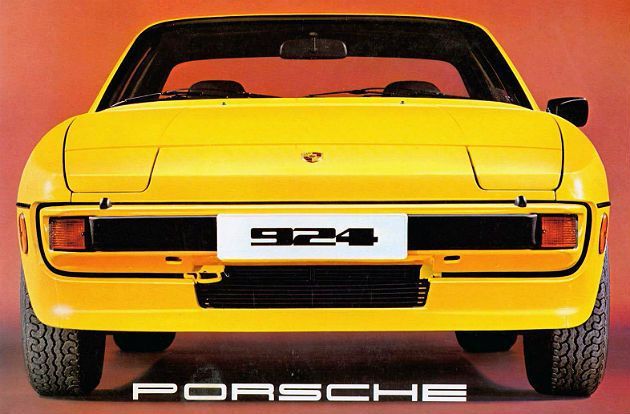 The paragraphs above could fit nicely in any modern car's brochure. Few, however, would venture to even entertain the thought that they, in fact, describe a car created nearly 40 years ago. 40. This little car embodies Porsche's old-world traditions and methods of design, engineering and manufacturing. The 924 wasn't just some mass- produced "Volks-Porsche," this was a car that was largely hand-built by craftsmen who welded sheet metal, brazed seams and sanded any irregularities on the finished body by hand. Few will realize that hand-sewing upholstery and hand-assembly of engines and gearboxes wasn't limited to the 911 or the 928 that immediately followed. The 924 was borne of the same methods. There's a reason why this car cost the equivalent of roughly $45,000 in today's money; being entry level wasn't synonymous with being cheap. |
||
 08-05-2015, 07:04 PM
|
|
|
Registered
|
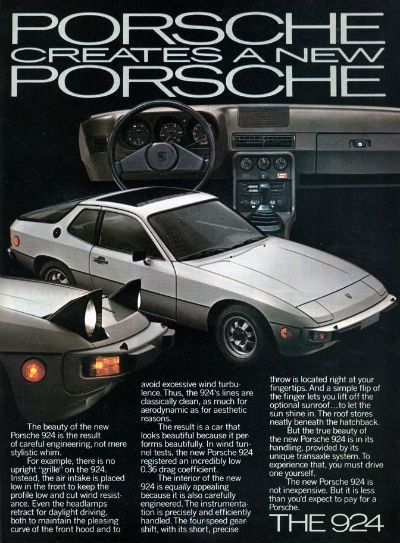 Porsche had gone back to their roots in a sort of indirect way with the 924. Some may point to the 356, correctly suggesting how close in relation they seem, primarily with dependence on Volkswagen componentry. But that would be simplistic without understanding the fundamental difference. Whereas the 356 was conceived from a dream Ferry Porsche and his father had to one day build a sports car of their own, the 924's stormy conception was borne of marketing reports, spreadsheets and serendipity. This is not to say the 924's roots don't run deep, they do - far deeper than the 356. The 924 utilized a concept Dr. Ferdinand Porsche created for Daimler-Benz that would be used on its W25 in 1934 and subsequent Grand Prix racers along with Ferrari, Lancia, Maserati and Alfa-Romeos - the transaxle. You can't get any deeper than that. To truly appreciate the 924 is to accept it as a new beginning for Porsche, one of necessity rather than desire. It's a car that utilized available resources in savvy ways but maintained the spirit instilled into every Porsche before it. It would be unfair to simply wave it off as a cobbled-up creation by two companies in the midst global economic uncertainty. The badge it wears on its nose was earned, not simply affixed. Mark these words: This little number will be the next darling of budding collectors on this side of the Atlantic. The 924 is a sensible vintage Porsche that is sophisticated enough for modern times and can be used practically on a daily basis. Few can claim such a virtue. It was and still remains what is arguably the best entry-level Porsche that delivers an unfiltered experience with innocent simplicity. After nearly 40 years since being presented to the world, has the 924 finally come of age? 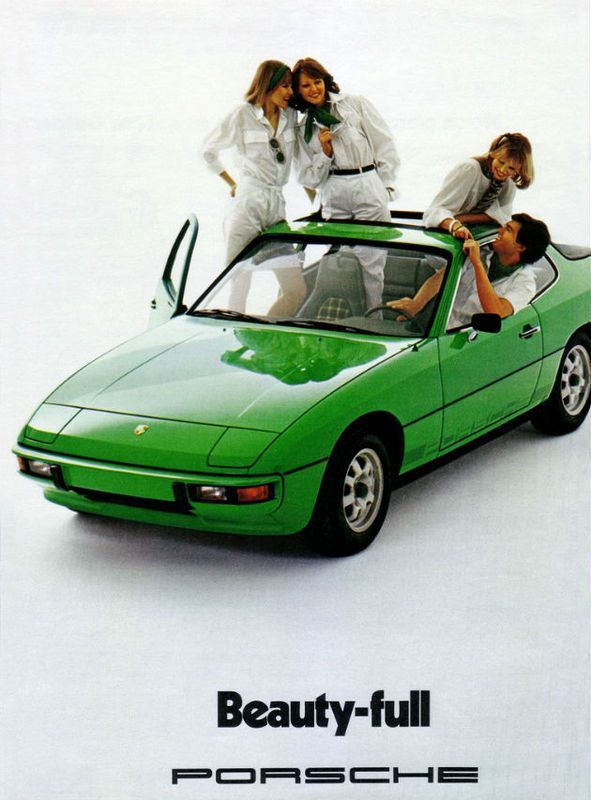 About the Author Pablo Deferrari A dyed-in-the wool, air-cooled 911 junkie, Pablo Deferrari doesn't discriminate against other Porsches. Want further proof? He's in love with Porsche's early water-cooled models and is dedicated to the celebration of the 924, 928, 944 and 968 series. Pablo is one car away from having all four of these models in his own collection: the 924. Pablo Deferrari pablo.deferrari@flussigmagazine.com MultiBrief: The perfect entry-level Porsche But we already knew this! |
||
|
08-05-2015, 07:05 PM
|
|
|
Registered

|
Good engineering and value are timeless. They manifest themselves in each decade. P51B, C, D, K Mustang, Messerschmitt BF 109, F86 Sabre Fighter, Tomcat F14, Hornet F18 for aircraft. Porsche 356, 911SC, 911 Carrera, Porsche 924/944/968, Ford 150, Chevy vette and Camaro and Pontiac GTO for autos. Nimitz Class Supercarrier, Seawolf Submarine and the Space Shuttle for the ultimate in complex high tech machines of diplomacy. They evolve into the future. Awesome.
|
||
|
08-05-2015, 07:29 PM
|
|
|
Registered
Join Date: Nov 2011
Posts: 26
|
Great article and where stated the comparisons to the 911 of the day shows that not because it cost less, it was any less engineered. i certainly didn't know the reason for the pointed covers on the dials. the colors of the times were definitely fetching. then they made the 924 carrera, 944 / 968 and turbos and rs cars. i really like these. thanks for sharing.
|
||
|
08-06-2015, 06:18 AM
|
|
|
Registered

Join Date: Feb 2009
Location: Park Hills, KY
Posts: 2,459
|
just read that. reinforces my recent interest in 944s.
__________________
Bob Cox 78 930 clone project car. 87 924S resurrect at some point. 84 928S, Ruby Red linen/brown interior - sold  86 944 turbo my new DE/track car - sold
|
||
|
08-06-2015, 09:10 AM
|
|
|
Registered User

|
Thanks for posting my article fasteddie!
e̶l̶ ̶j̶e̶f̶e̶
__________________
pablo deferrari Editor in Chief and founder of flüssig magazine NNJR PCA Member PCA's E-Brake newsletter contributing writer www.flussigmagazine.com |
||
|
08-06-2015, 03:44 PM
|
|

|
|
Registered
|
Quote:
 I think it's great!
__________________
80 931S LSD-G31 Big Breaks FMIC 1 Bar so far |
||
|
08-10-2015, 09:02 PM
|
|
|
Registered User
Join Date: May 2015
Posts: 106
|
I appreciate your work and style, Pablo.
When I was a kid in the '80s, all I wanted to do with my life was to write for a car or motorcycle magazine. I spent my wasted high school years in Pennsylvania, skipping class to read Road & Track and Car & Driver, poring over tales of Testarossas and 930s. Not wanting to take an acetic's vow of poverty, I squashed those dreams as adulthood took over. So, I can appreciate entrepreneurs like you who put it all out there and make the investment. Adopting a 1986 944 has brought those New Wave-heyday feelings back, like seeing young Christie Brinkley's Playboy pictures inside my 10th grade hall locker. Like a sighting of the Alpine Countach poster that we all had hung on the bedroom wall. But, this whole thing has made me wonder, is the 924 a Porsche at all, or merely a rebadged VW?    
|
||
|
08-12-2015, 03:27 PM
|
|
|
Registered User
|
Thank you Boulder, your words mean so much. The 924 will forever carry that stigma of being a Volks-Porsche much like the 944 was considered the Hausfrauenporsche...but these attitudes are a bit dated as more and more enthusiasts are realizing just how misunderstood these Porsches were all along.
If the 356 were created in place of the 924, would it be considered a rebadged VW? Doubtful. They both have a helping of VW pieces but the engineering around those pieces are purely Porsche and that's what counts. The 924 is no less a Porsche than the 924 for those reasons. Like I mentioned in the article, the main difference between the two is the reason each was created in the first place. By the way, you should rekindle your old flame of writing...it never leaves you and I'm sure with the amount of experience you've accumulated since then, it'll be richer than ever. I'd be honored to showcase it on flüssig's website.
__________________
pablo deferrari Editor in Chief and founder of flüssig magazine NNJR PCA Member PCA's E-Brake newsletter contributing writer www.flussigmagazine.com |
||
|
08-12-2015, 04:37 PM
|
|
|
Registered User
Join Date: May 2015
Posts: 106
|
That is a very kind and gracious offer, Pablo. I have done some writing with my international adventure motorcycle travel in Central and South America. I really should carve the time out in my life and document some of my adventures on six continents.
I was actually being facetious about the VW comment, given all of the vitriol and passion that it stirred up over on Rennlist! I was just trying to be funny. Keep up the good work on flussig. It is a joy to see adrenaline lifestyle and automotive enthusiasm presented in a modern way Sent from my SCH-I545 using Tapatalk |
||
|
08-12-2015, 07:20 PM
|
|
|
Registered
Join Date: Jun 2010
Posts: 15
|
I just logged back in for the first time in years to come research a project car for me and my sons. I have just about settled on a 944 or 968 - this reinforces that I'm on the right track.
|
||
|
08-12-2015, 08:18 PM
|
|
|
Registered

|
This article is a fantastic read and has me going back to reread it multiple times. It's even sparked some interest in the 924 in me even though I've already got a 944.
I'm curious, was the 944 built in the same way the 924 was?? With hand-welded sheet metal and assembly of engines and gearboxes and bodies, and hand-sewn upholstery? 
__________________
Karl '80 931-Dolomite Gray -> Monaco Blau '74 911-Guards Red |
||
|
08-20-2015, 08:50 PM
|
|
|
Registered User
|
Hi Karl, I'm glad you enjoyed the article. There was A LOT of hand assembly/work at Neckarsulm and Zuffenhausen (944 engines/928/968 production). I'm in the middle of compiling factory images documenting the assembly of Porsches at the former NSU plant and in Zuffenhausen; in the meantime, here are a few videos I've posted on flüssig's website. Enjoy—
928/944 engine assembly circa 1986: Porsche factory tour 1986—944 and 928 assembly - f l ü s s i g m a g a z i n e 924 commercial image film porsche 924/924 turbo commercial imagefilm - f l ü s s i g m a g a z i n e
__________________
pablo deferrari Editor in Chief and founder of flüssig magazine NNJR PCA Member PCA's E-Brake newsletter contributing writer www.flussigmagazine.com |
||
|
08-21-2015, 05:00 PM
|
|
|
Registered User
|
here are some assembly shots:
924 assembly 1  making of 944 S2 cab image 1  making of 944 S2 cab image 2  931 body finishing  944 rear quarter stamping  944 paint work  924s going down the line  968 body prep  968 production  968 production 2 
__________________
pablo deferrari Editor in Chief and founder of flüssig magazine NNJR PCA Member PCA's E-Brake newsletter contributing writer www.flussigmagazine.com |
||
|
08-21-2015, 05:13 PM
|
|
|
Registered User
|
968 production 3
 968 production 4  924/931 production shots  924 production  924 drive train assembly  924 final checks 
__________________
pablo deferrari Editor in Chief and founder of flüssig magazine NNJR PCA Member PCA's E-Brake newsletter contributing writer www.flussigmagazine.com |
||
|
08-21-2015, 05:27 PM
|
|
|
ltfisher
|
Great pictures! Thanks for posting these.
|
||
|
08-21-2015, 11:48 PM
|
|
|
Registered User
Join Date: Jul 2015
Location: Central Mass
Posts: 12
|
Great article and pics, Thanks for posting!
|
||
|
08-22-2015, 04:31 AM
|
|
|
Registered
Join Date: Nov 2011
Posts: 26
|
hmmm... making the 944 s2 cab, not as elegant as i thought. i meant cs in my first post.
|
||
|
08-24-2015, 02:30 PM
|
|


 1980 Porsche 931
 1996 Porsche 911
 1987 Porsche 944S
 1979 Porsche 928
 Cannot think of a name yet...
 Erika
Erika Ernst
Ernst
